Why we need shared private internets
Once upon a time all conversations were private.
Two people in dialogue. A small group in a debate. What was said only left the room if someone decided it should.
For all of human history until two decades ago, private communication was the default. Words traveled as far as our voices could carry them. Or, if we chose, we wrote them down in formats with the intention of distribution.
The internet changed this. What was shared between two people could now be observed and reshared by the world. Our feelings, personal information, and who we talked to became data distributed to corporations, governments, and agencies beyond our control. With our explicit-ish consent on social media, and without it through widespread surveillance in support of ad-based models and suspicious states.
We've gone from a world that's default private to a world that's default public. Lured by the ever-present promise of infinite scale, human interaction shifted from private exchange to public arena. Even when we think what we're doing is private. No one agreed to this except through byzantine terms of use none of us read.
The performative cultures, insincere provocations, and broken social contracts that surround us today are the result.
Why we need dark forests
This was the tension I felt in 2019 when I wrote "The Dark Forest Theory of the Internet." I'd grown up on the early web where message boards, blogs, and a less centralized internet made a degree of privacy the assumed state of things. But the internet I wrote about seven years ago had become something else: a battleground where being visible meant being exposed.
Back then I observed that I and a growing number of others were moving "into dark forests to avoid the fray." Dark forests were group chats, private spaces, and podcasts that had more in common with the physical world than with the internet we knew. Wary of being watched, afraid of being taken out of context, and tired of threats from trolls and adversaries, people changed how they showed up.
That trend has accelerated. We now live in a world where everything public feels like an ad and the only things that feel real are private. We use the public internet to make money and achieve social status, accepting that being open online also means being less safe.
Why we need privacy
There's a powerful book from 2020 by Oxford philosopher Carissa Veliz called Privacy Is Power that explains why this matters. She writes:
"Privacy is about being able to keep certain intimate things to yourself — your thoughts, your experiences, your conversations, your plans. Human beings need privacy to be able to unwind from the burden of being with other people. We need privacy to explore new ideas freely, to make up our own minds. Privacy protects us from unwanted pressures and abuses of power."
What I felt personally, Veliz diagnoses politically. When the primary means of distributing information become less safe, we all suffer. Through the demands of public performance, tyranny reigns.
What's true of individuals is also true of groups. Trust requires believing that values and desires are shared. New ideas need to be debated privately before being scrutinized publicly. Ideas among people can grow even bigger when they aren’t immediately broadcast to all.
We've gotten so used to the default of thinking infinite scale is a good thing, we've come to think of privacy as a bad thing. But wanting privacy isn't a retreat. Craving more space for your ideas doesn’t mean you're doing something dangerous. Privacy is about having agency over your own thoughts and words, and how far they spread. Privacy is about control.
The missing middle
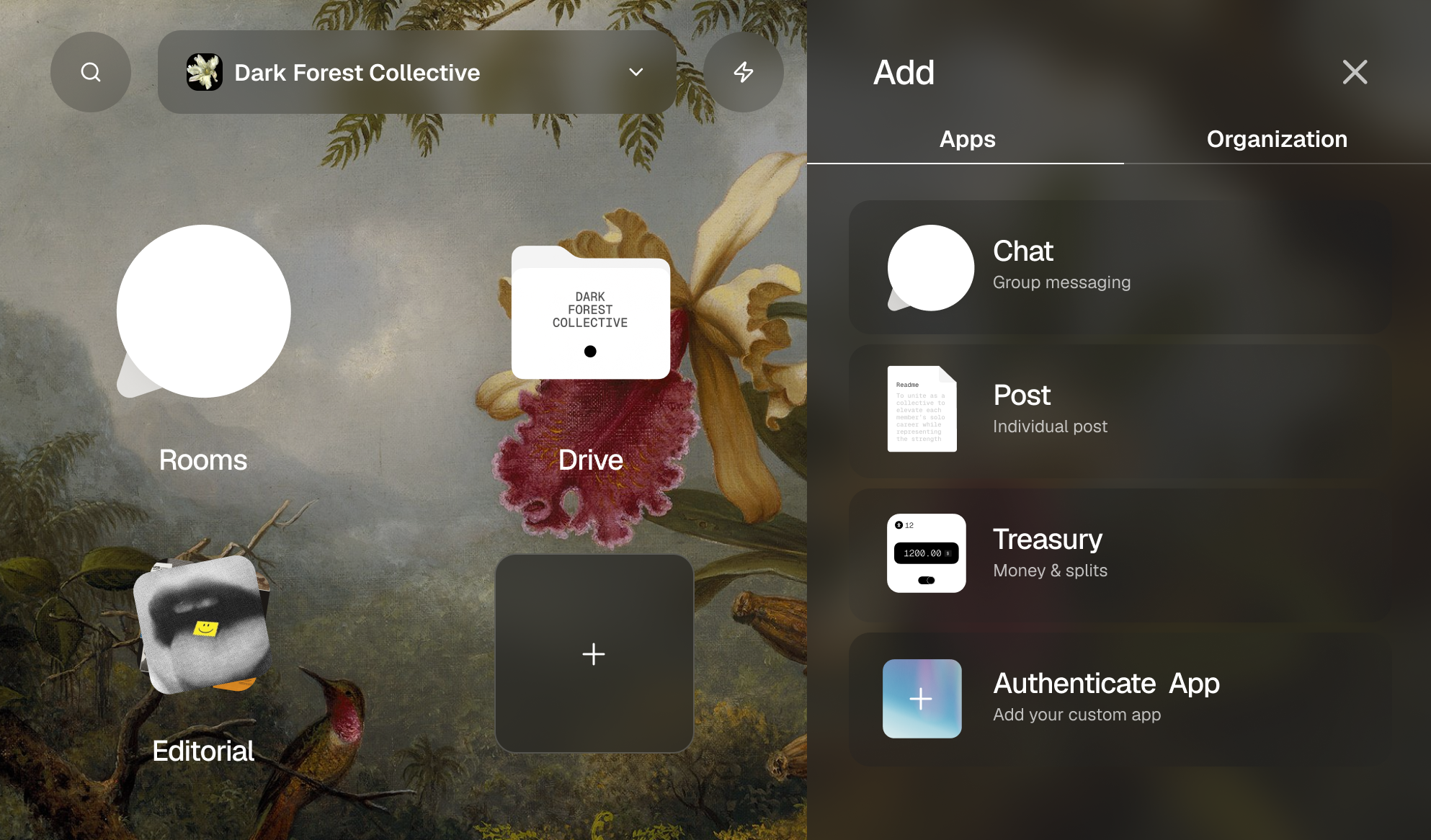
DFOS is an attempt to build the missing middle. The space where creative projects and culture get made (see earlier essays here and here). A space for the groups and communities that the current internet doesn't understand because they don't want to play today's attention games. Spaces that feel more like the physical world than the scaled internet we increasingly avoid.
We think of these as shared private internets. De-scaled spaces that take advantage of all the powerful tools of the web while intentionally limiting unwanted reach.
We're using software to make this, but the goals aren't technical. They're applied philosophy. The values and experiences of how we want to live — safe, secure, connected — expressed as implements that help us get there.
When we're stuck between what we don't want and what we can't have, somebody needs to break the dam. Probably a lot of somebodies. Eventually, instead of choosing between one or the other, there’s a better third thing. And just maybe, over time, a world where choosing more privacy doesn’t mean choosing less power.
We need shared private internets. Not because we want more technology or scale. Exactly the opposite. We want more time with each other. We want to feel safe. We want to be ourselves, whoever we are.