Dark forests and the new internet
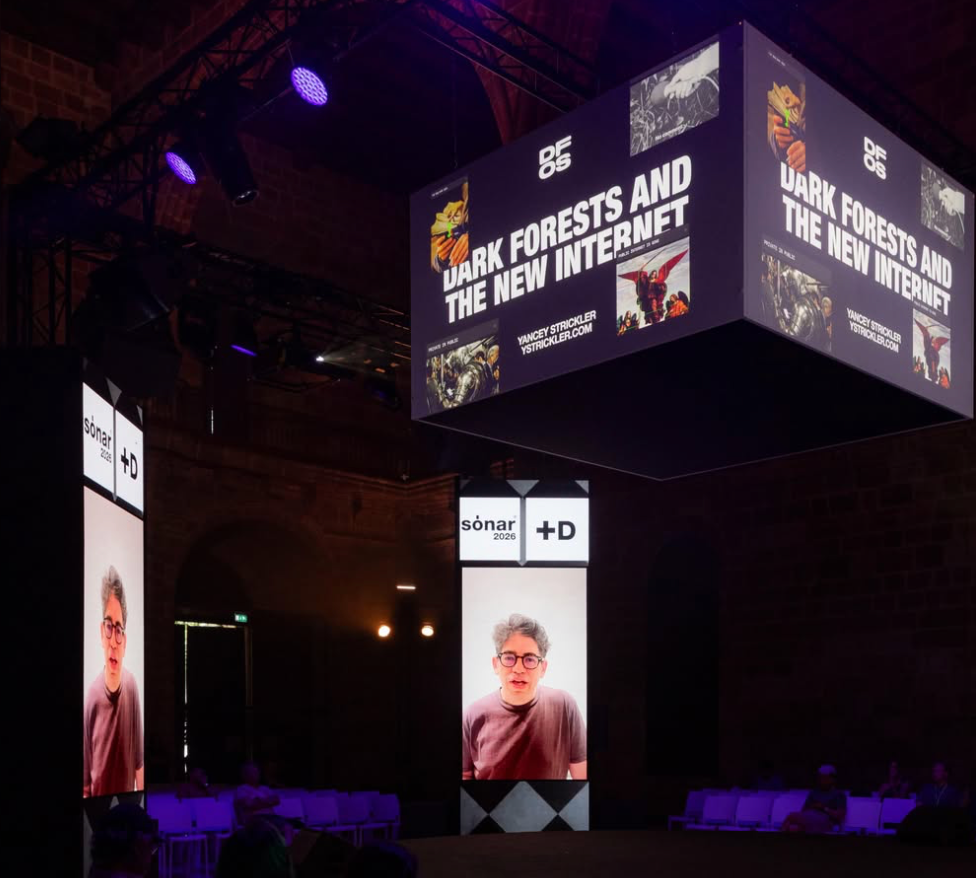
Last week we spoke remotely at the Sonar Festival in Barcelona. This is the text and slides of our talk.
My name is Yancey Strickler. Thank you for having me.
Today I'm going to talk about how we and society are changing. In ways that are uncomfortable and ways that are very different from the present.
I don't endorse all of these ideas, nor do I think they lead to simplistic or purely positive outcomes. I'm here speaking as a witness, sharing the parts of the picture that I see.
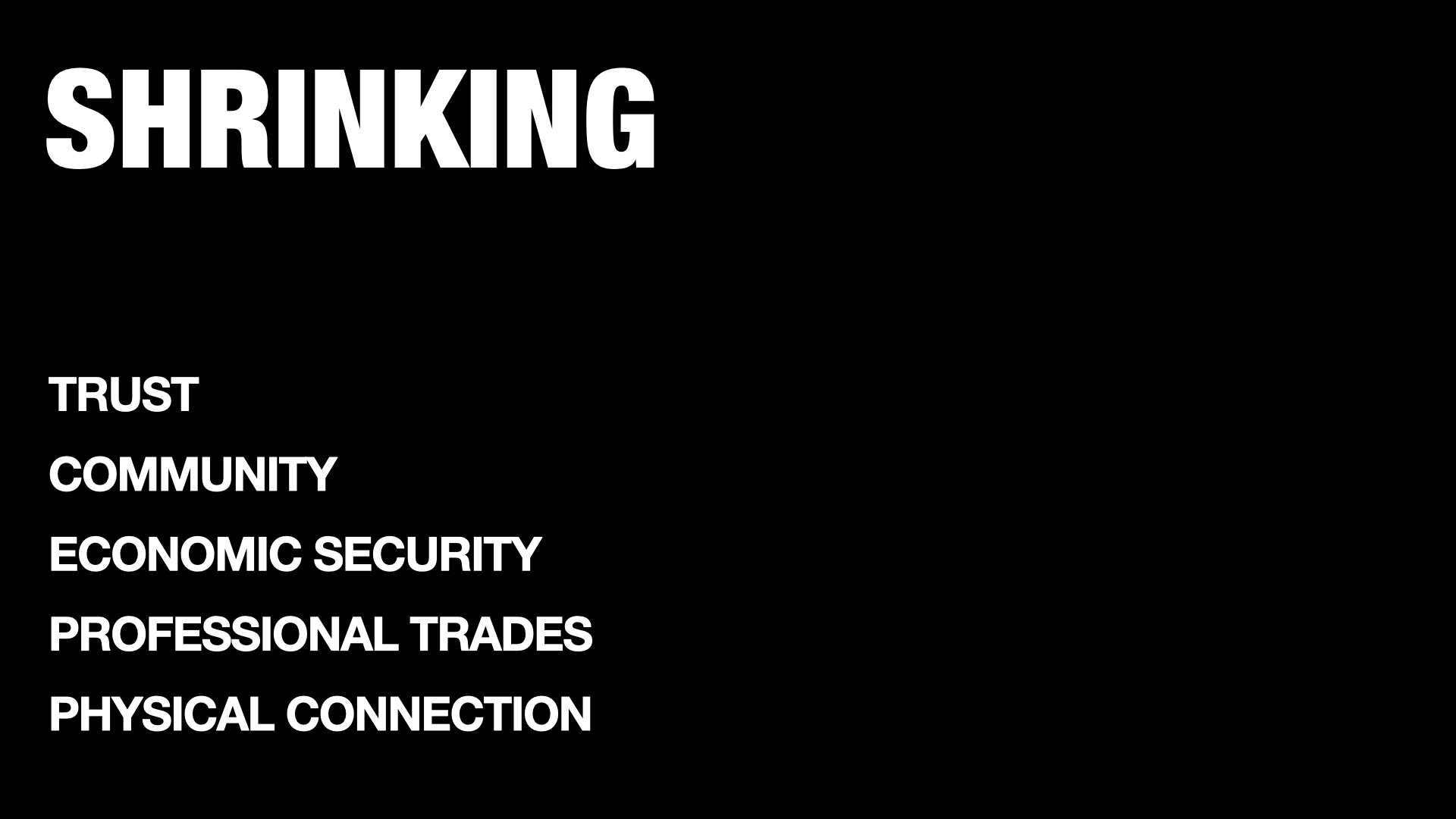
There's an unusual feeling in the air. Parts of life feel increasingly scarce. Areas where there used to be soft tissue and durable muscle that held us together, we can feel their absence. It happened slowly, then all at once.
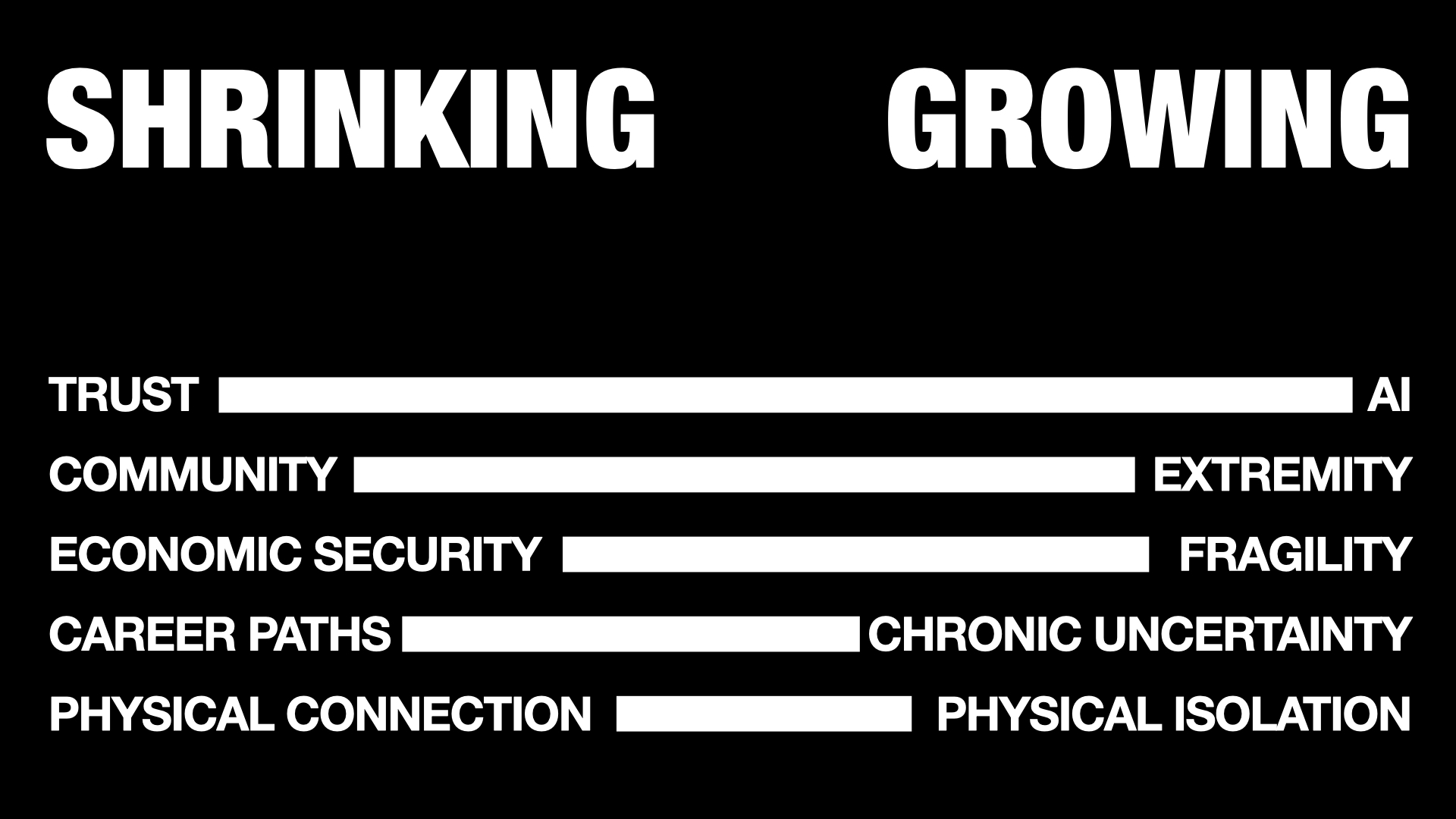
We see the ends of the highways. We've reached the parts of the ladder where rungs are missing. A free floating feeling. How long before gravity pulls us down?
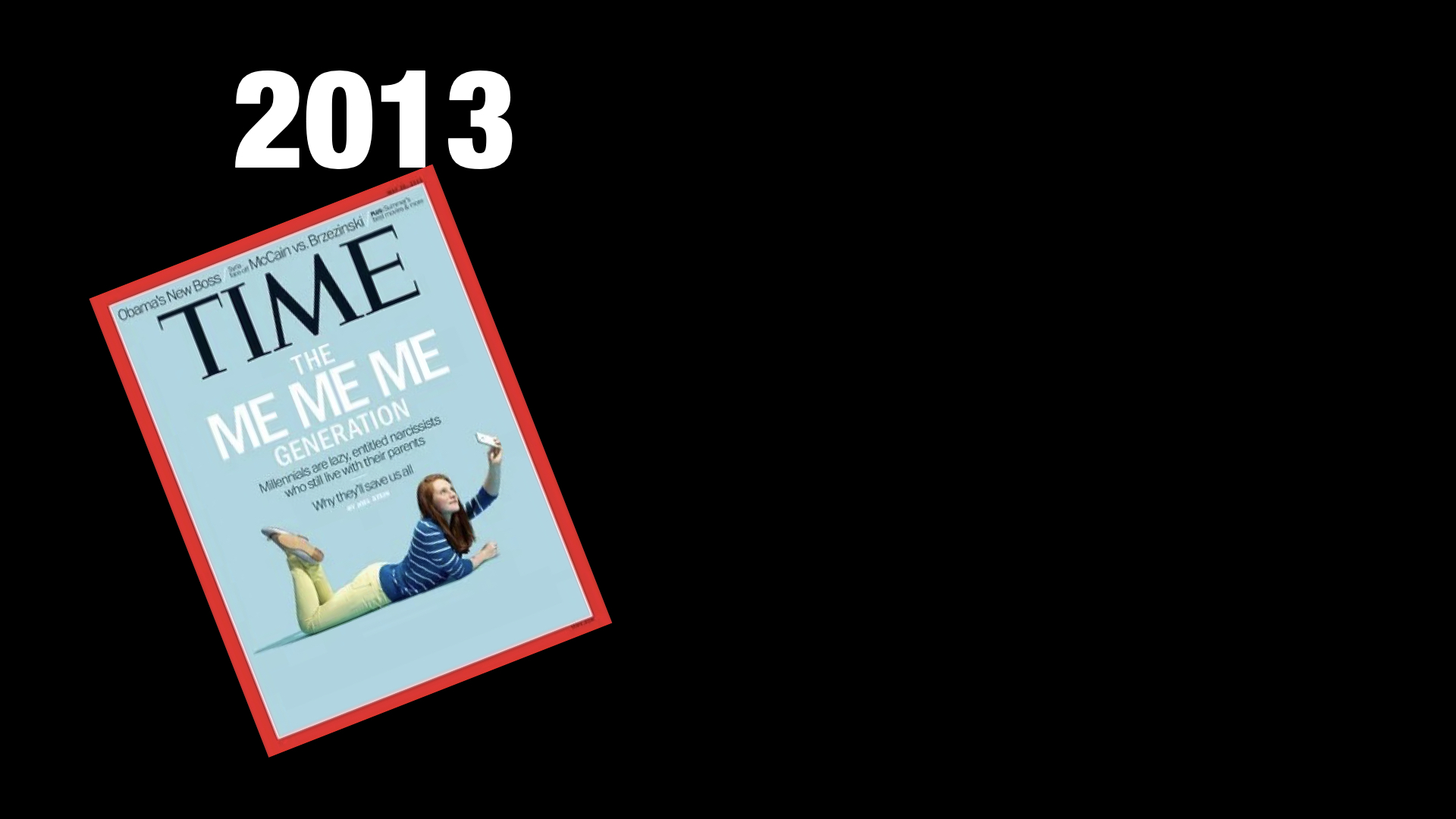
All of this starts with the internet, of course. Thirteen years ago social media was ascendent. The wide openness of the world felt like freedom.
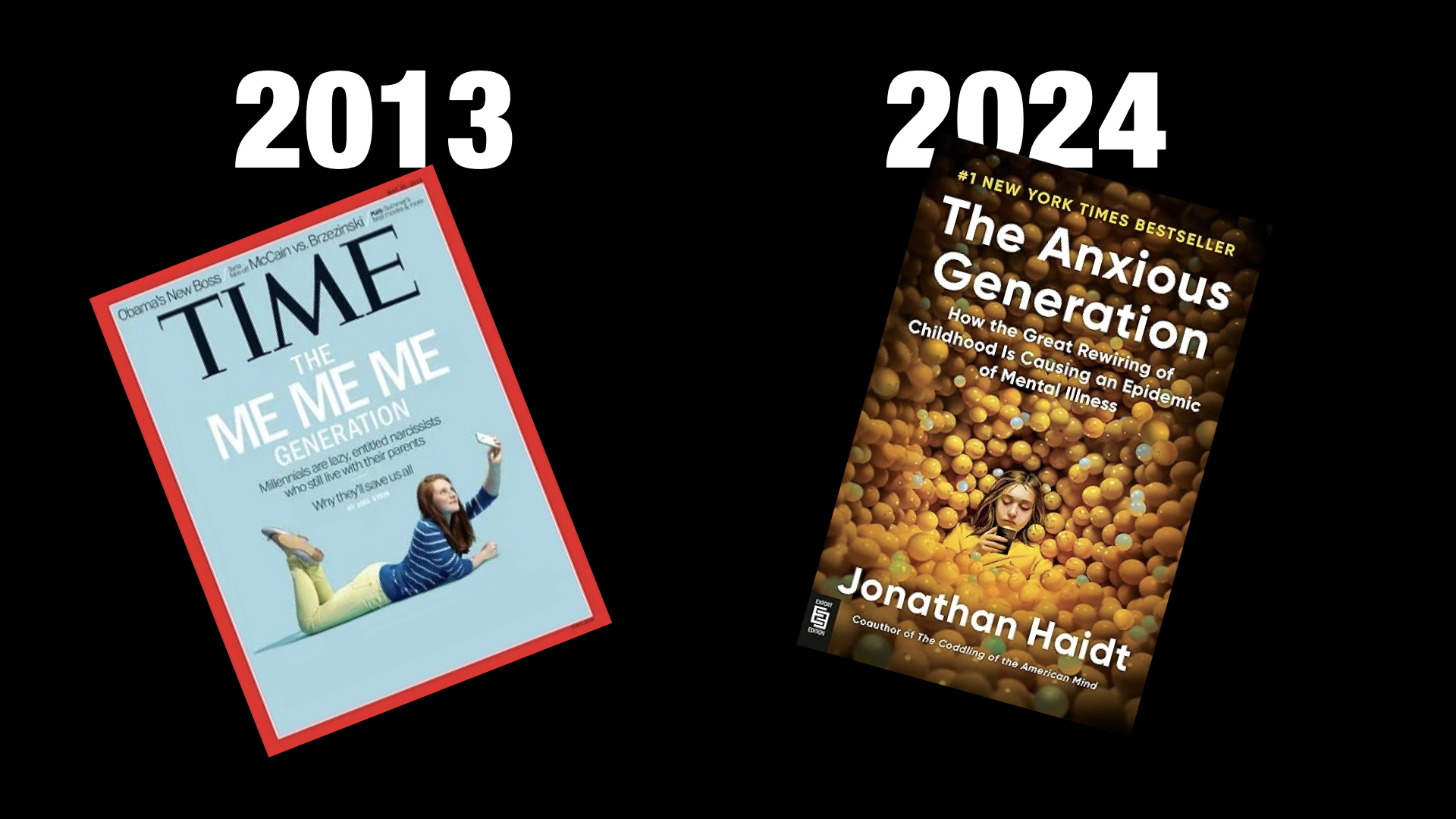
A decade later the consequences came. A society remade around the self-image, gameified and monetized.
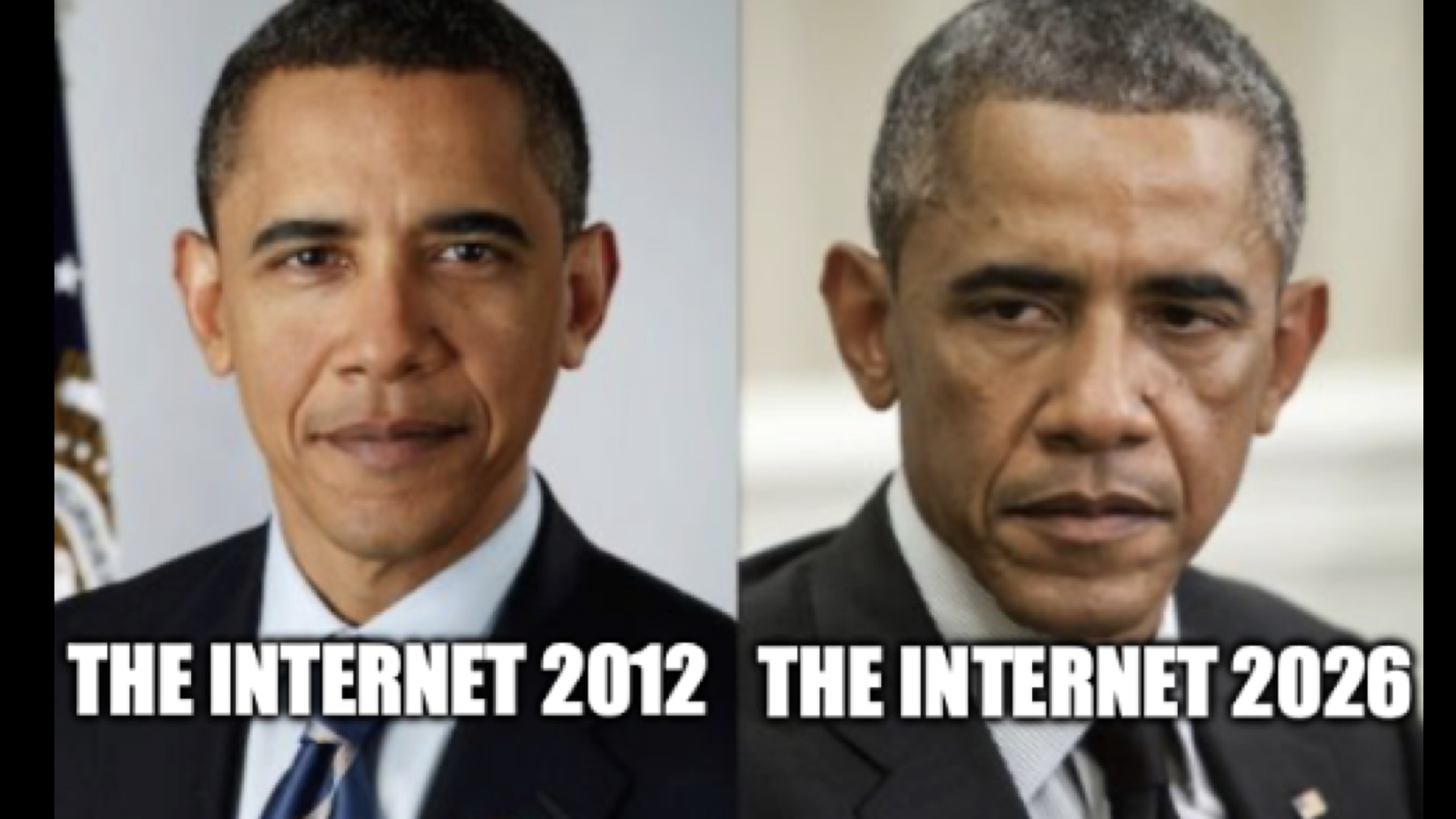
What happened? We accepted and normalized the potential of infinite scale. We monetized human society. We built a global slot machine — first for our attention, now, through betting, on top of everything.
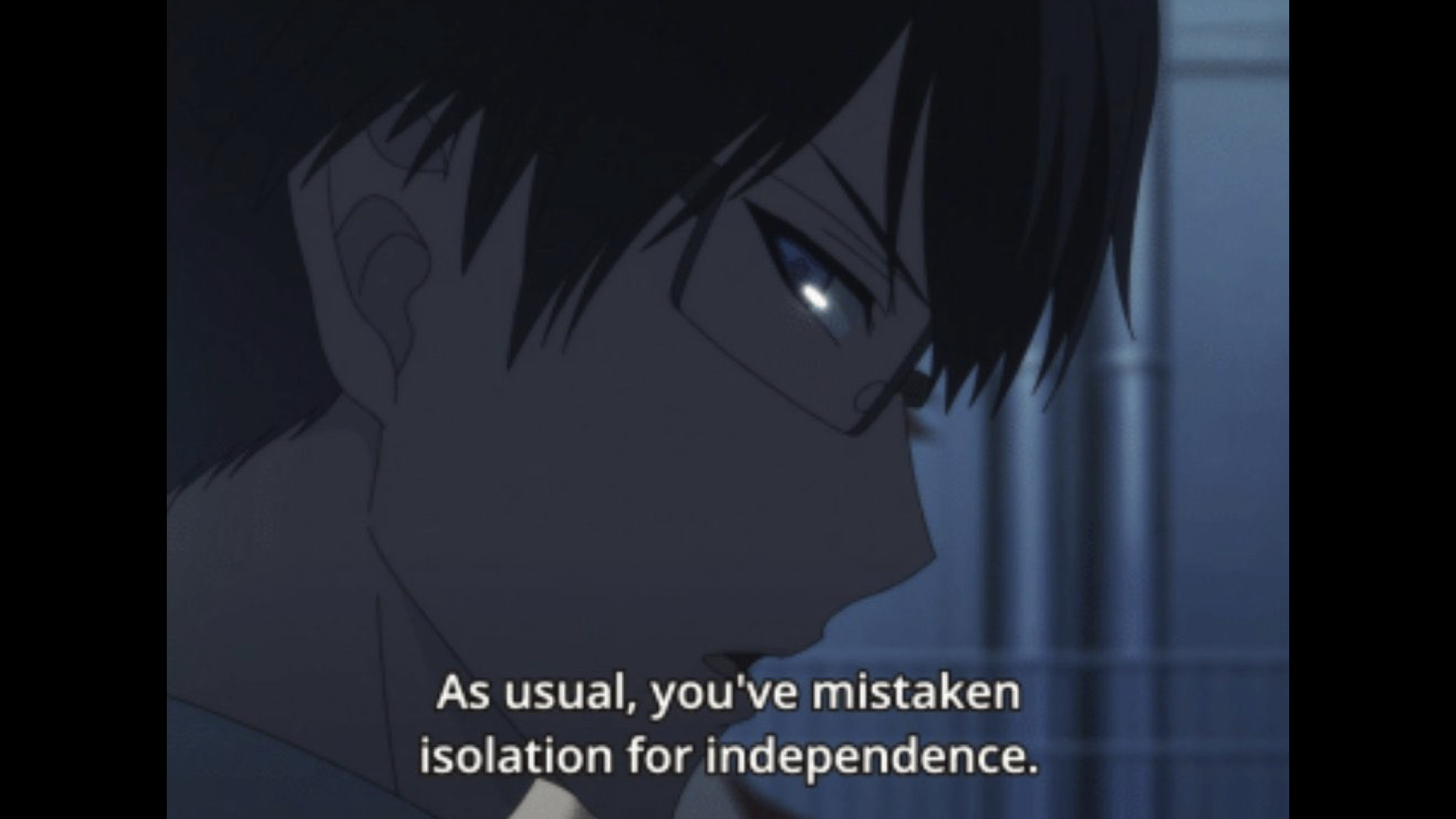
We played along because the cost-benefit seemed worth it. Type the right string of letters on Twitter and end up famous. Make enough videos of yourself and you could do it for a living.
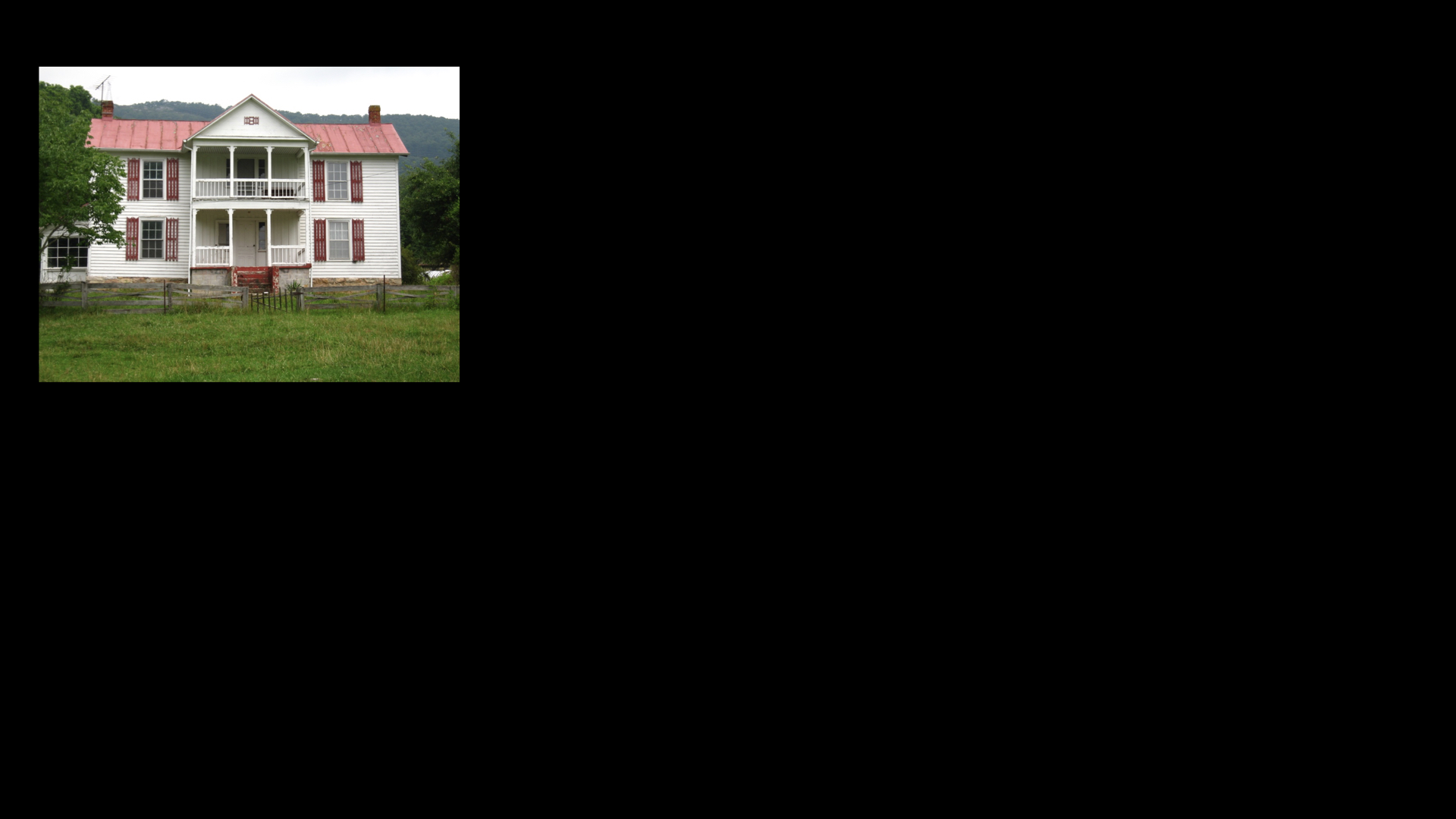
I'm a slightly earlier version of this, but not dissimilar. I grew up on a farm in Southwest Virginia, the son of a traveling waterbed salesman and musician, and my mom was a secretary.
My first job was as a music critic, writing for Pitchfork and the Village Voice. I started a tiny record label that put out music from bands a group of us saw at shows. I was active in message boards meeting people like me all around the world.
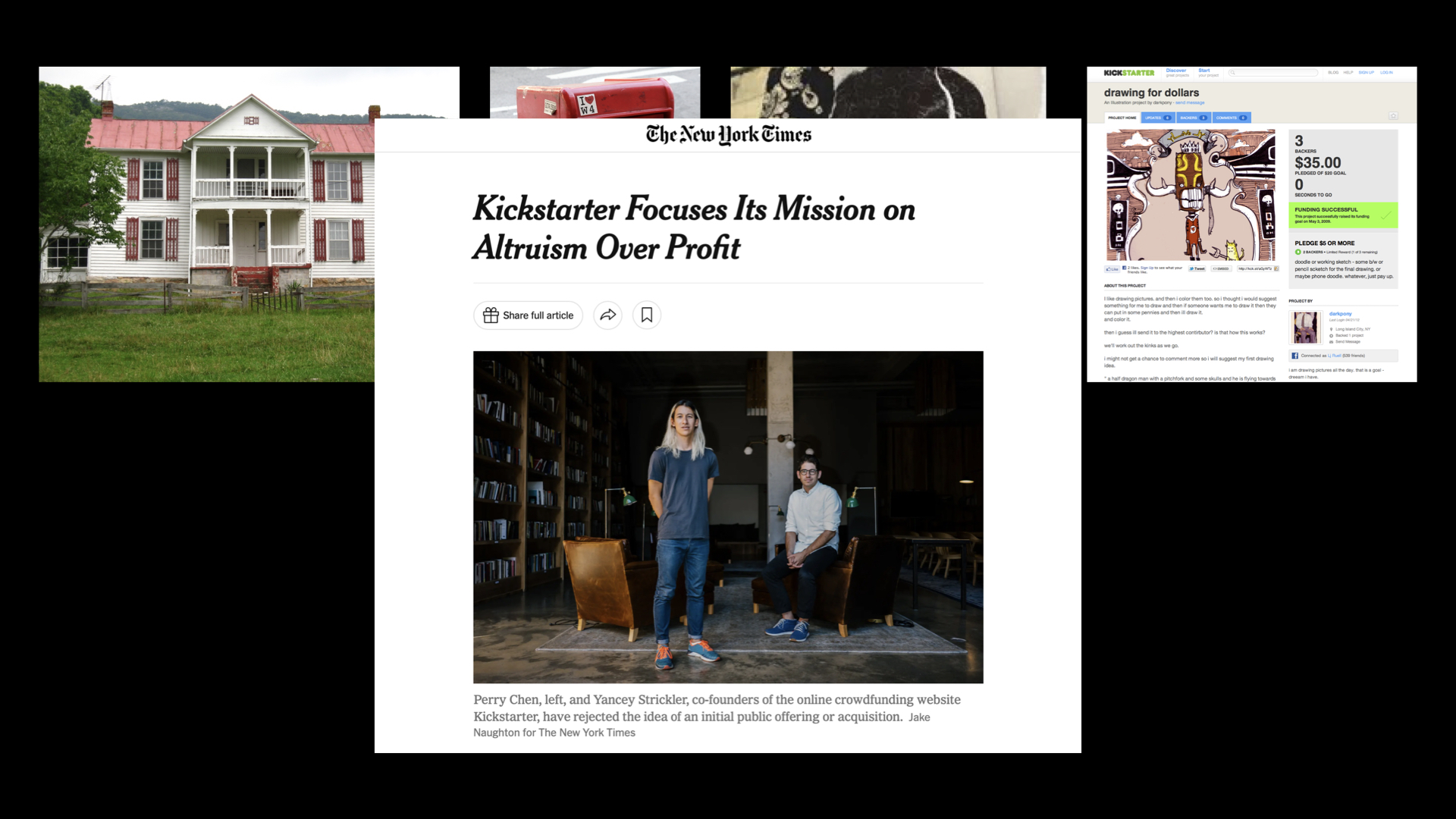
Around that time I met Perry Chen and Charles Adler, and we started working on Kickstarter. A way for creative people like us to raise money for projects without going through gatekeepers or middlemen. We wanted the company to stay true to its creative values, and became one of the first Public Benefit Corporations.
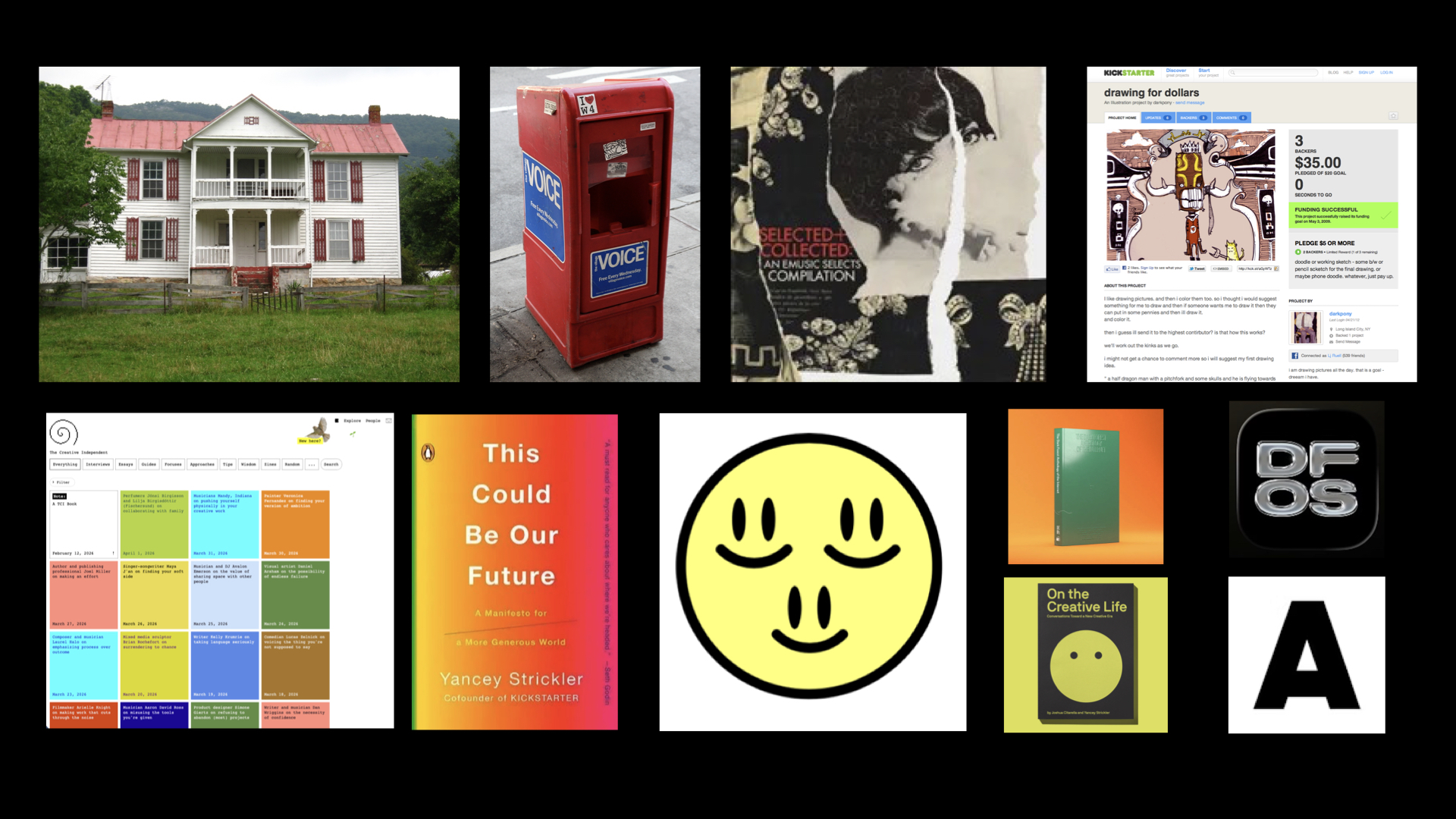
Since then I've continued to explore new models for supporting creative people and encouraging more collective connection generally. Three books exploring economics, the internet, and creative practices, and several projects supporting the creative ecosystem: The Creative Independent, Metalabel, Artist Corporations, and now DFOS.
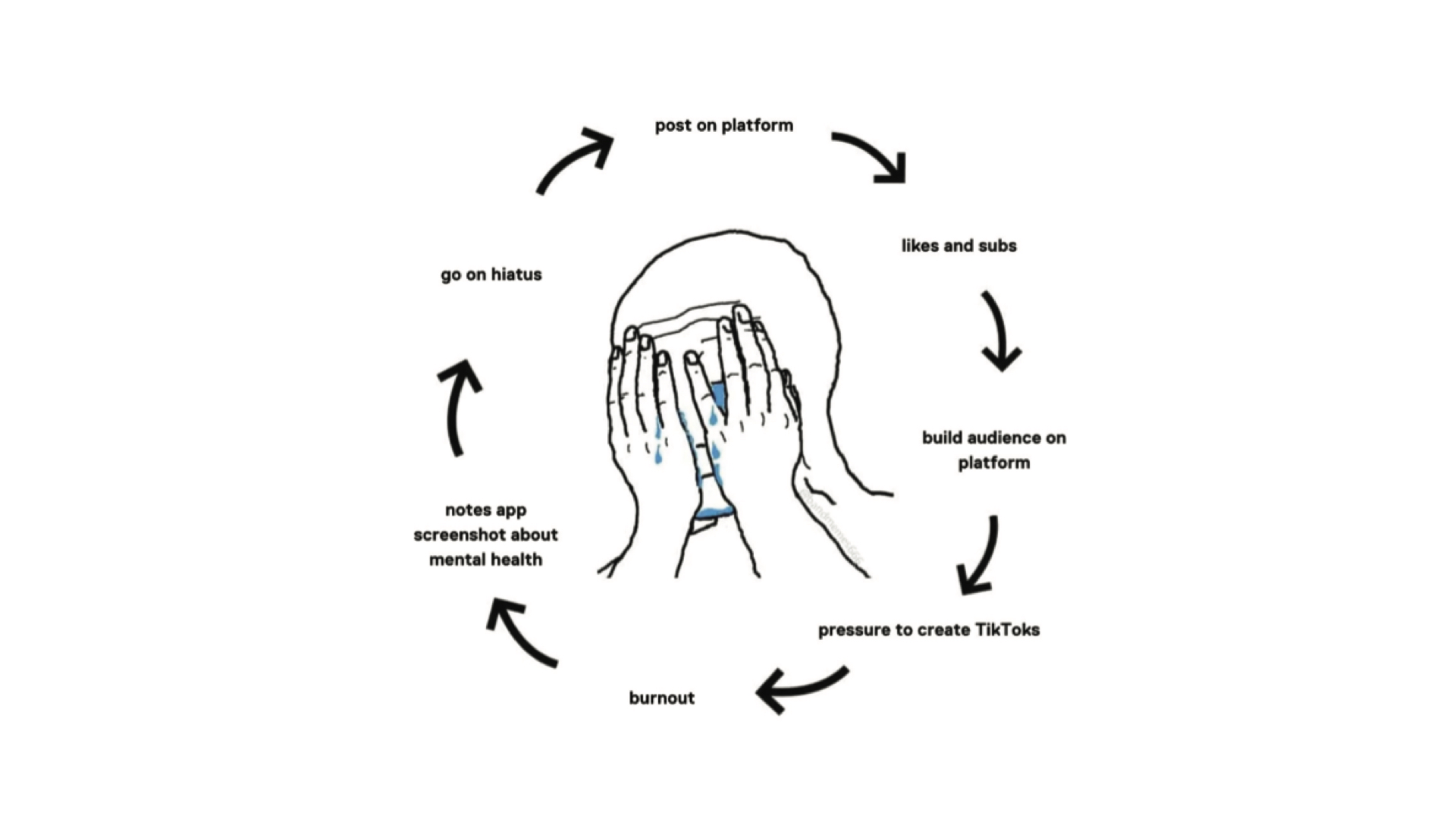
The period since Kickstarter has been driven by my own emotional experience as I returned to the life of being a writer after stepping down as CEO in 2017. I started a newsletter, a community, doing all of the things to create energy among a group of people. Yet I felt lonely, isolated, and weirdly competitive with people who did things like me. Eventually I had the embarrassing crash out where I had to put the project on hiatus. I didn't have the energy to do it anymore.
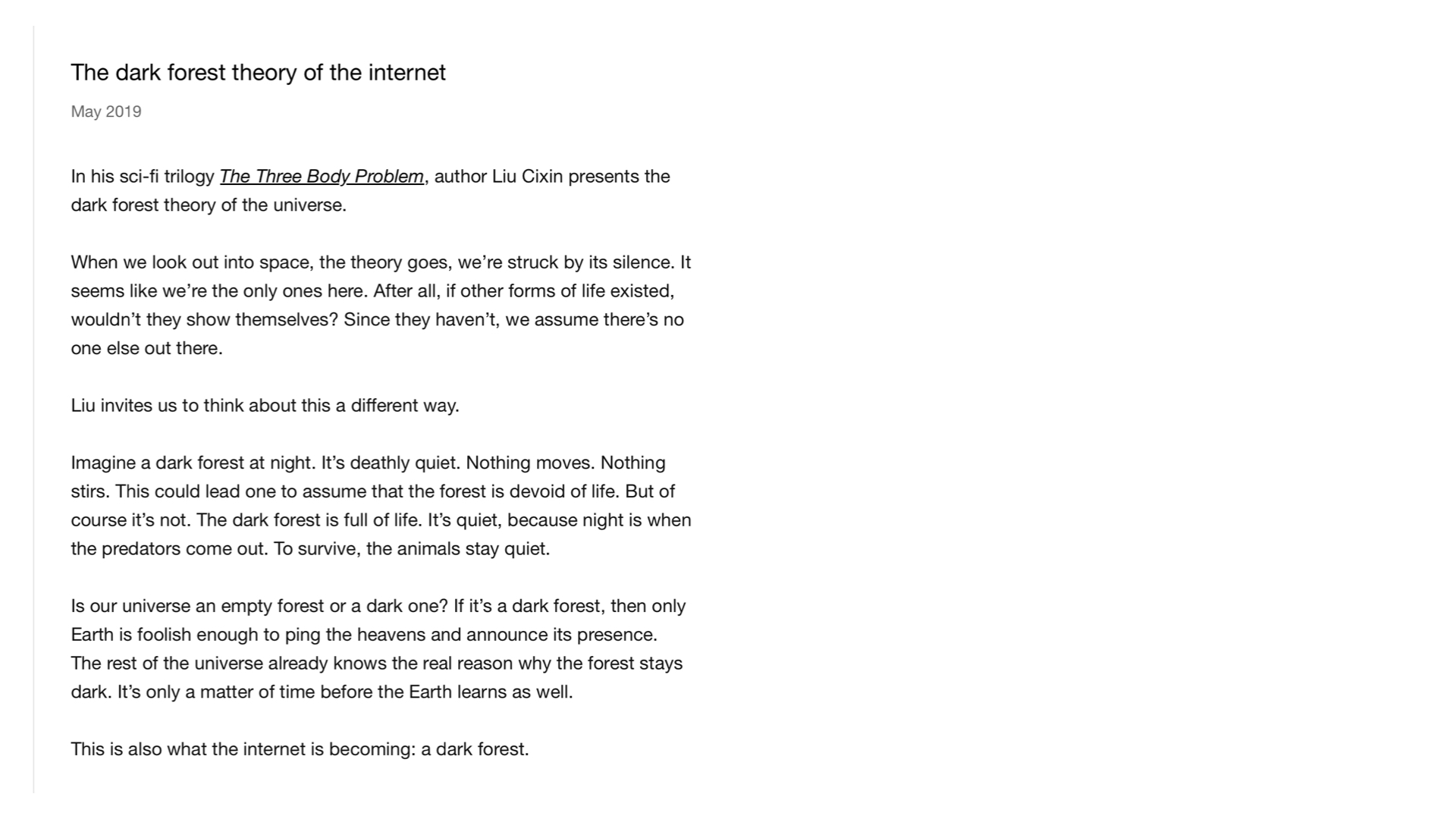
In May 2019 I sent an email to that newsletter list talking about my increasing reluctance to post online. I connected that feeling to an idea from the Chinese science fiction author Cixin Liu's Three Body Problem series of the Dark Forest. It goes like this:
We call our voices out into the universe announcing our presence. Because nothing calls back, we assume we're the only ones here. But think of a dark forest at night. You call out. Nothing calls back. The forest is still. Not because the forest is empty. Because it's full of predators who already know it's not safe.
This is what the internet was becoming, I wrote. A dark forest. We had moved away from the main channels and into groupchats, Discords, and private spaces where it felt safe. It wasn't the battleground or dangerous like main had come to feel.
This is the dark forest theory of the internet.
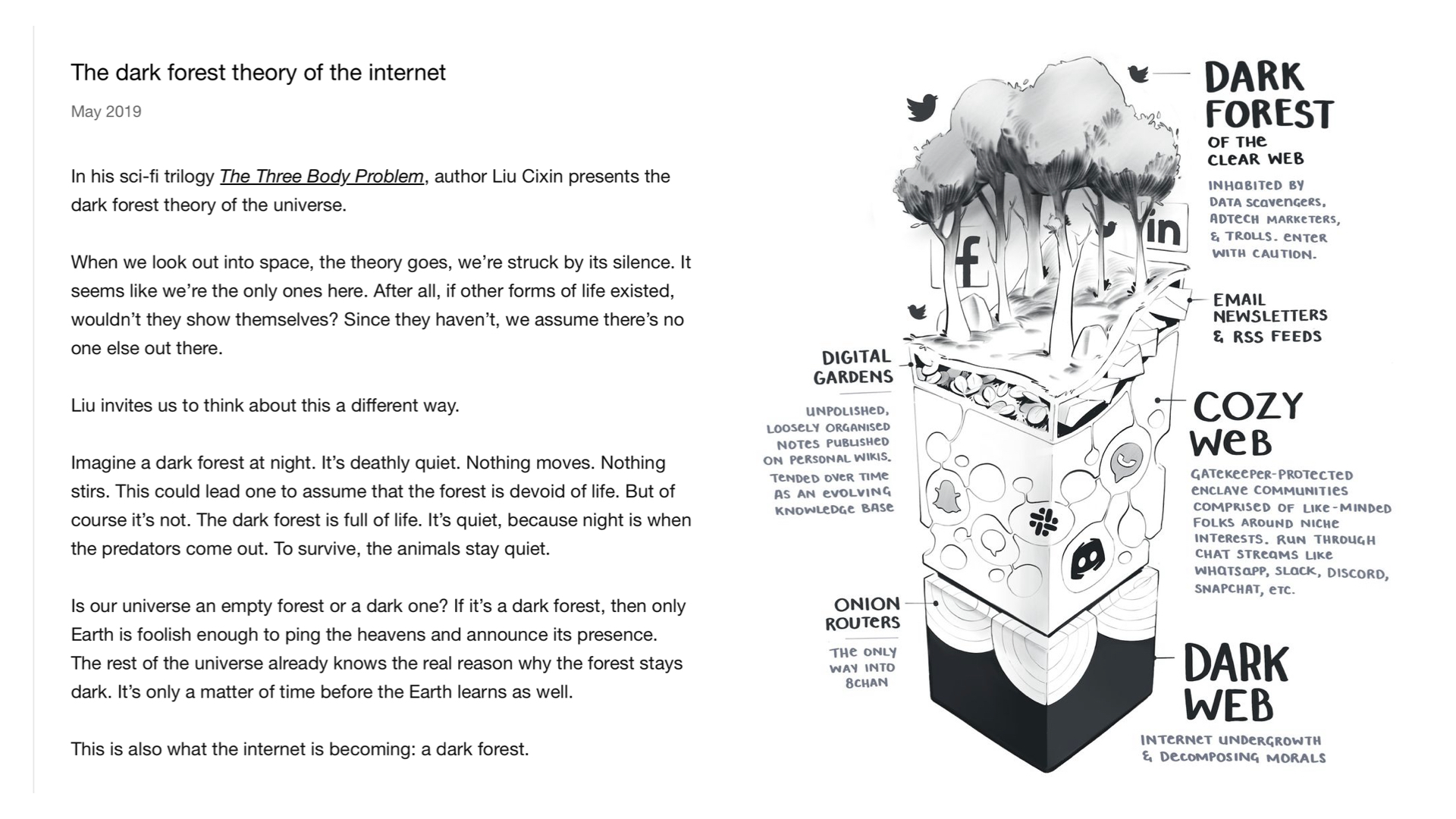
The email was sent to a tiny list, but it caught on. Venkatesh Rao built on the idea, introducing the idea of the Cozy Web. Maggie Appleton turned it into this amazing graphic. This emotion was something a lot of people were feeling.
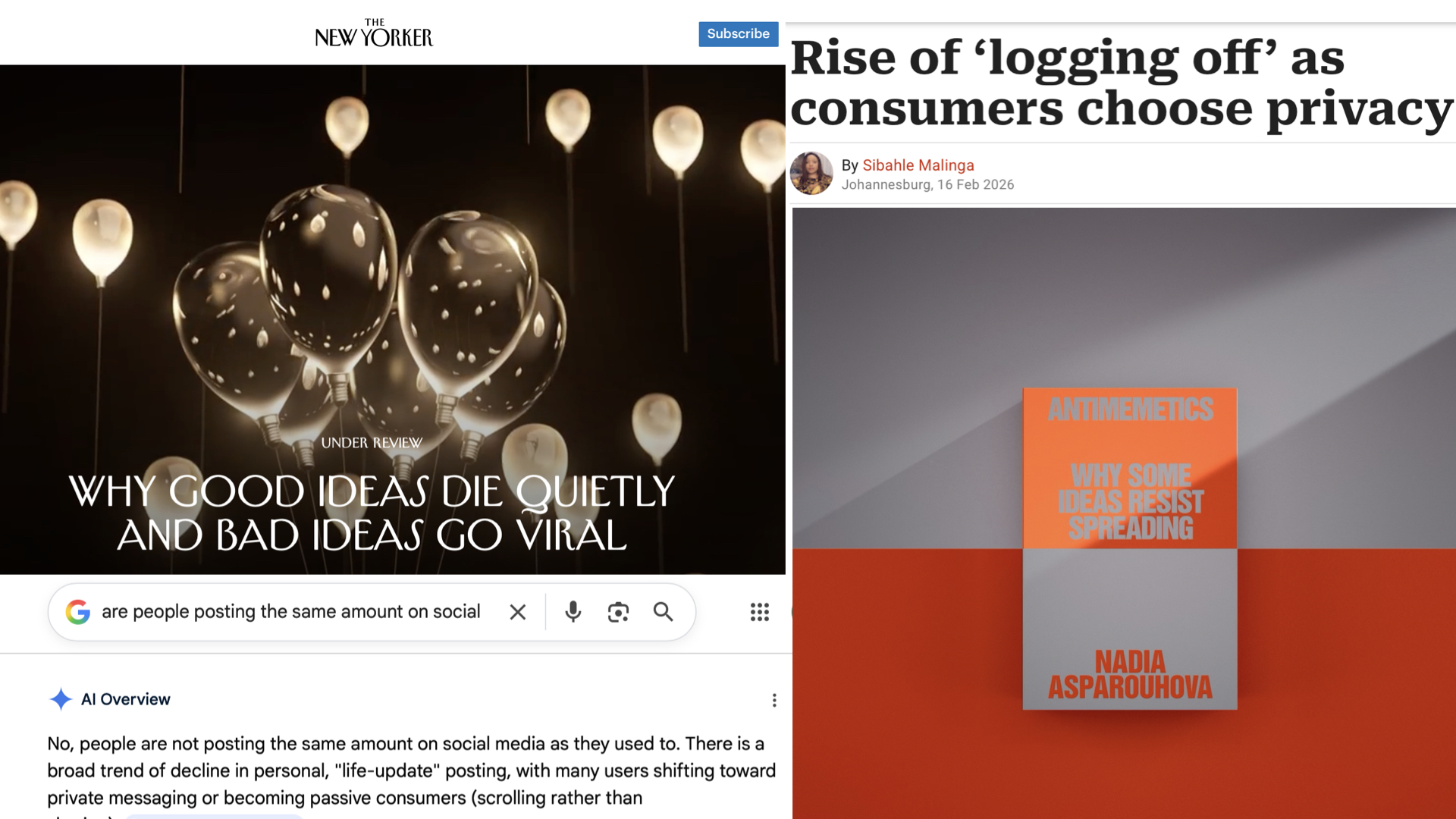
In the seven years since, the desire to be less seen online has grown. It shows up in the data of people posting less. It can be understood by the idea of antimemetics — or creating things that are designed not to be seen. This was an unthinkable desire back in 2013. Now it makes perfect sense.
But people are not going offline. They're becoming less public. More DMs, stories, and groupchats. Fewer posts to main. More lurking in the feed.
This is why everything public is an ad and everything private feels real. Every time I tweet something or post on Instagram I'm effectively creating an ad for my work. That's the reason I'm doing it. When I share in private channels, I’m being intimate with people I care about.
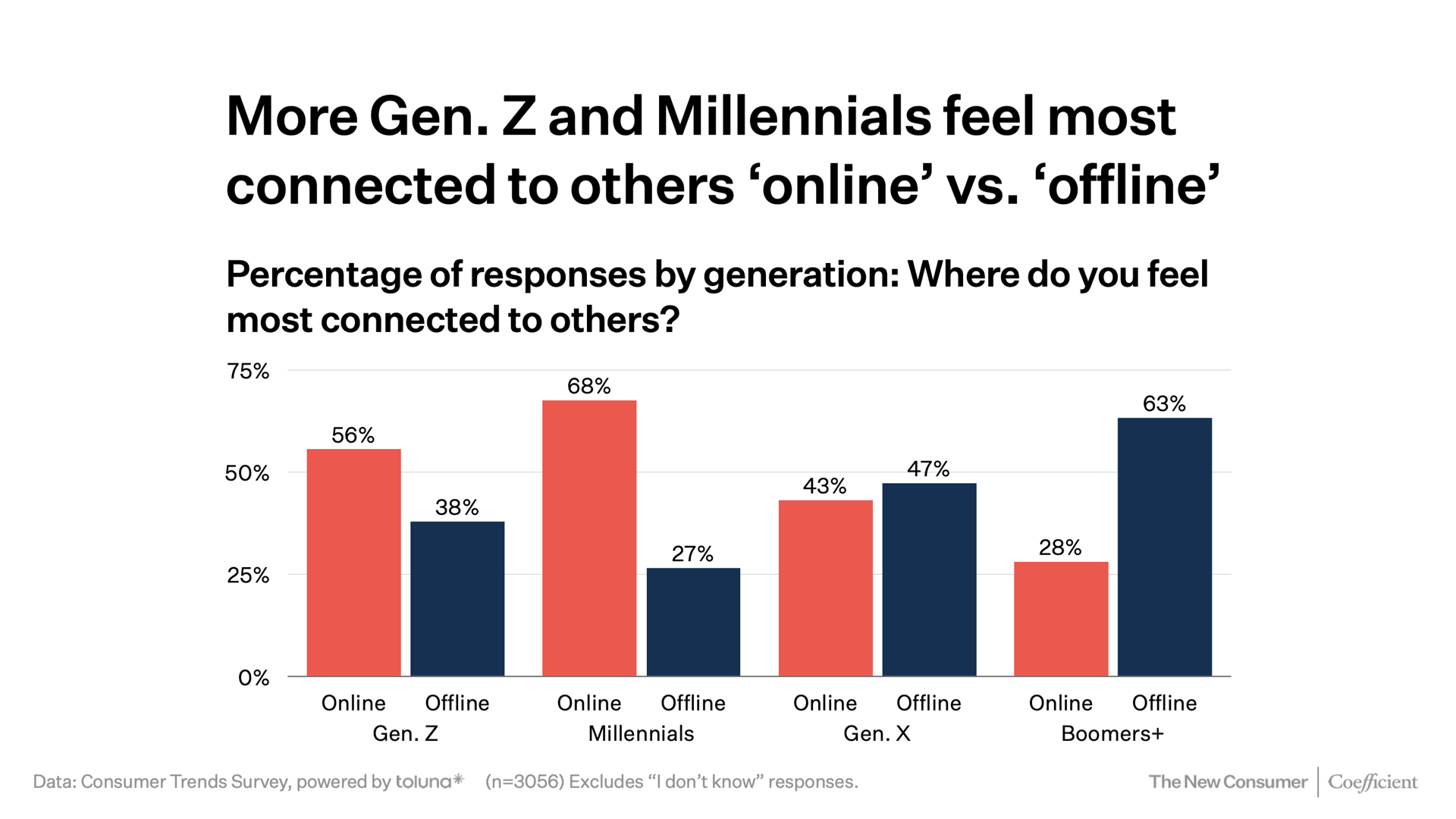
This weird disconnect becomes more deeply embedded the longer you've been inside it. Younger people feel much more themselves online where it's easier to see from behind the screen, to keep your identities separate, and be in control.
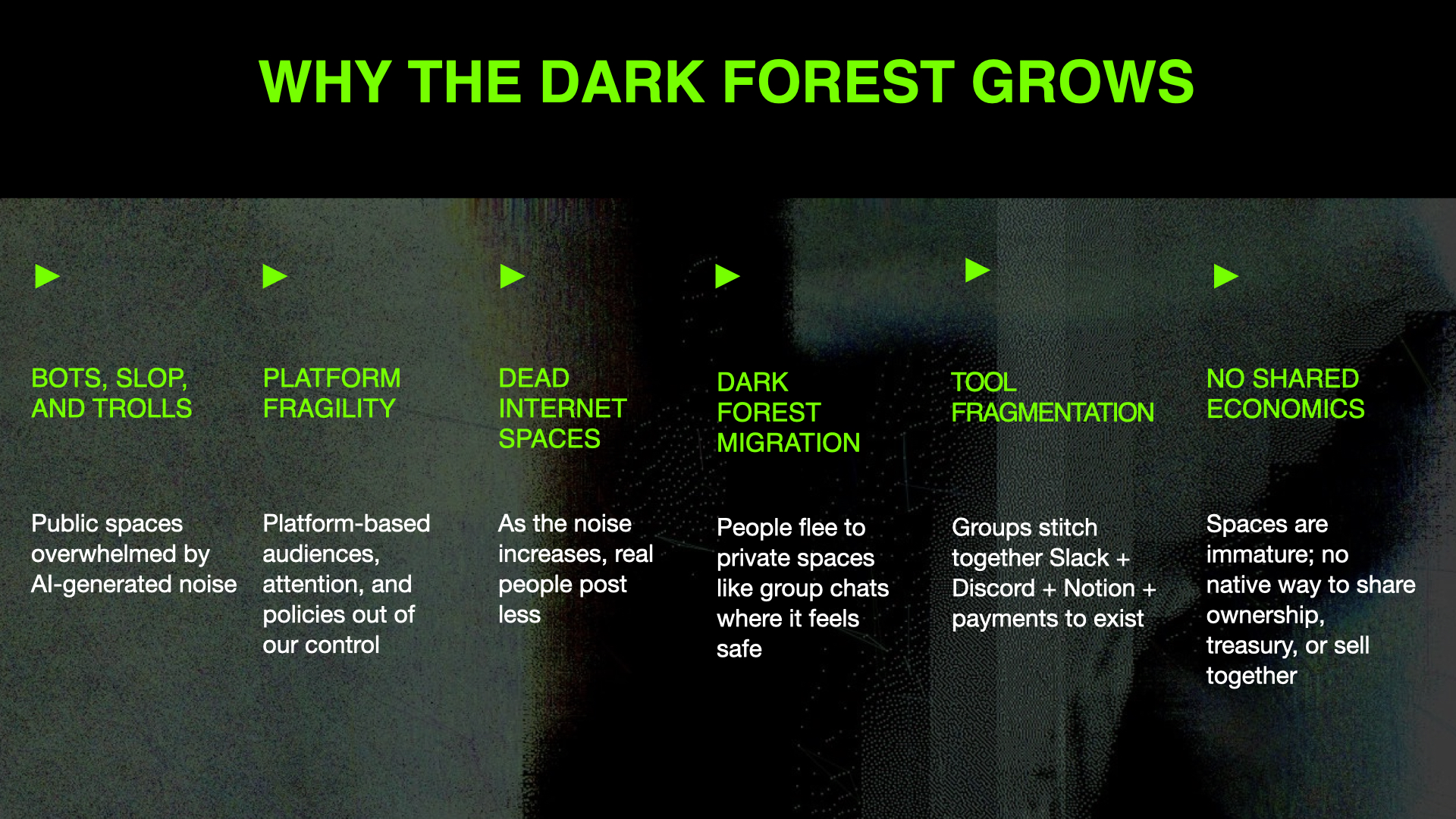
This is the energetic force pushing people into more private spaces. The public ones feel hostile and algorithmically oppositional. The rewards for being seen seem dubious. Do you really want more scrutiny? Do you actually want more time and reason to be on your phone?
This is where you might expect me to say go touch grass, be analog only, burn it all to the ground. Earlier versions of me have said that. Part of me still wants that. But time does not reverse. We can not go back. The people being born now will come up in this new normal. It is a disservice and unrealistic to design futures in which we imagine these technologies and dynamics do not exist.
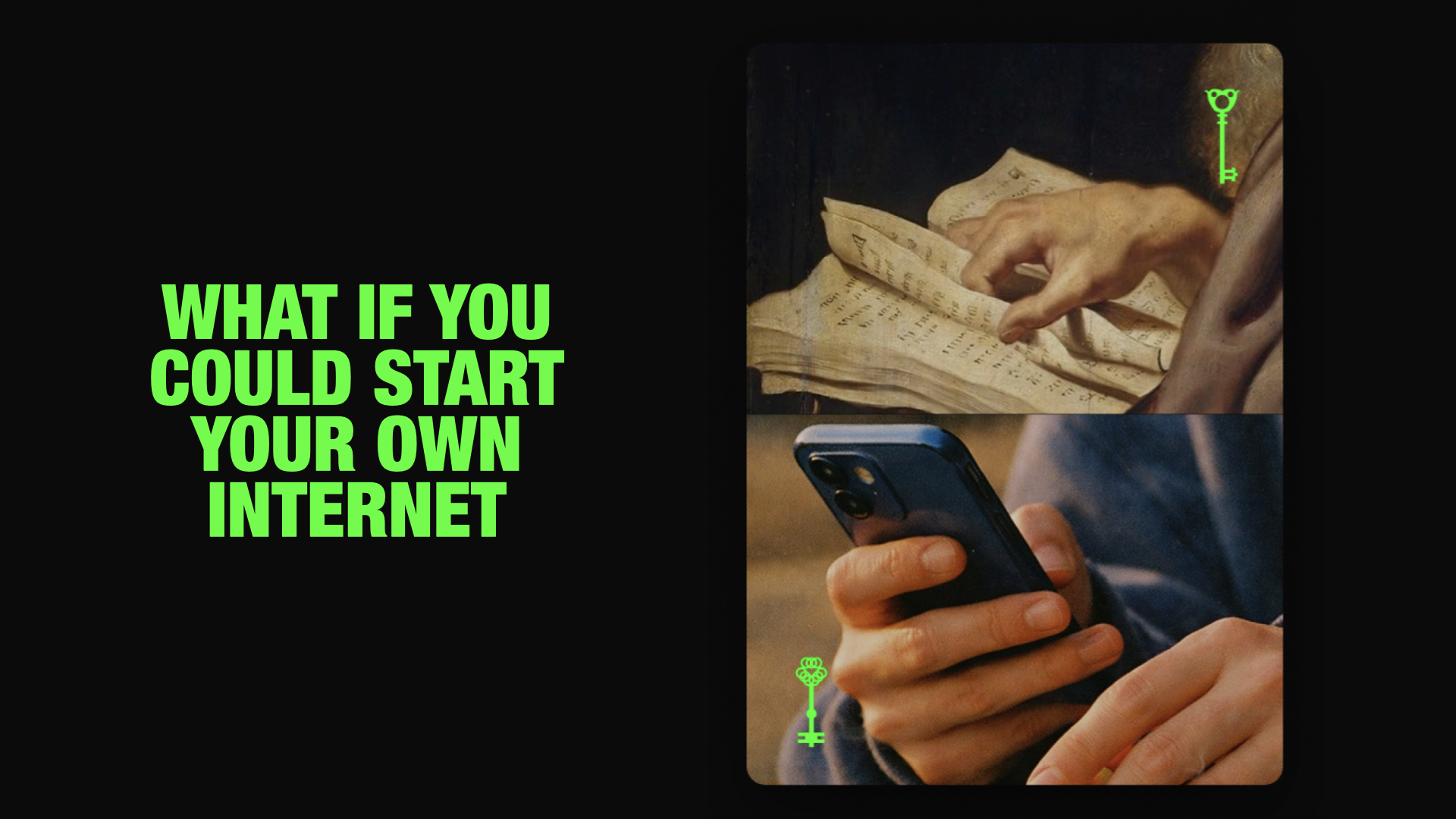
But it's also important to call out what's no longer working for us. The public internet as we know it today is cooked. Increasingly de-humanized. Economically antagonistic. Socially corrosive.
But people aren't spending less time on screens. They're just spending more of it in private spaces. The public internet is the past. The private internet is the future.
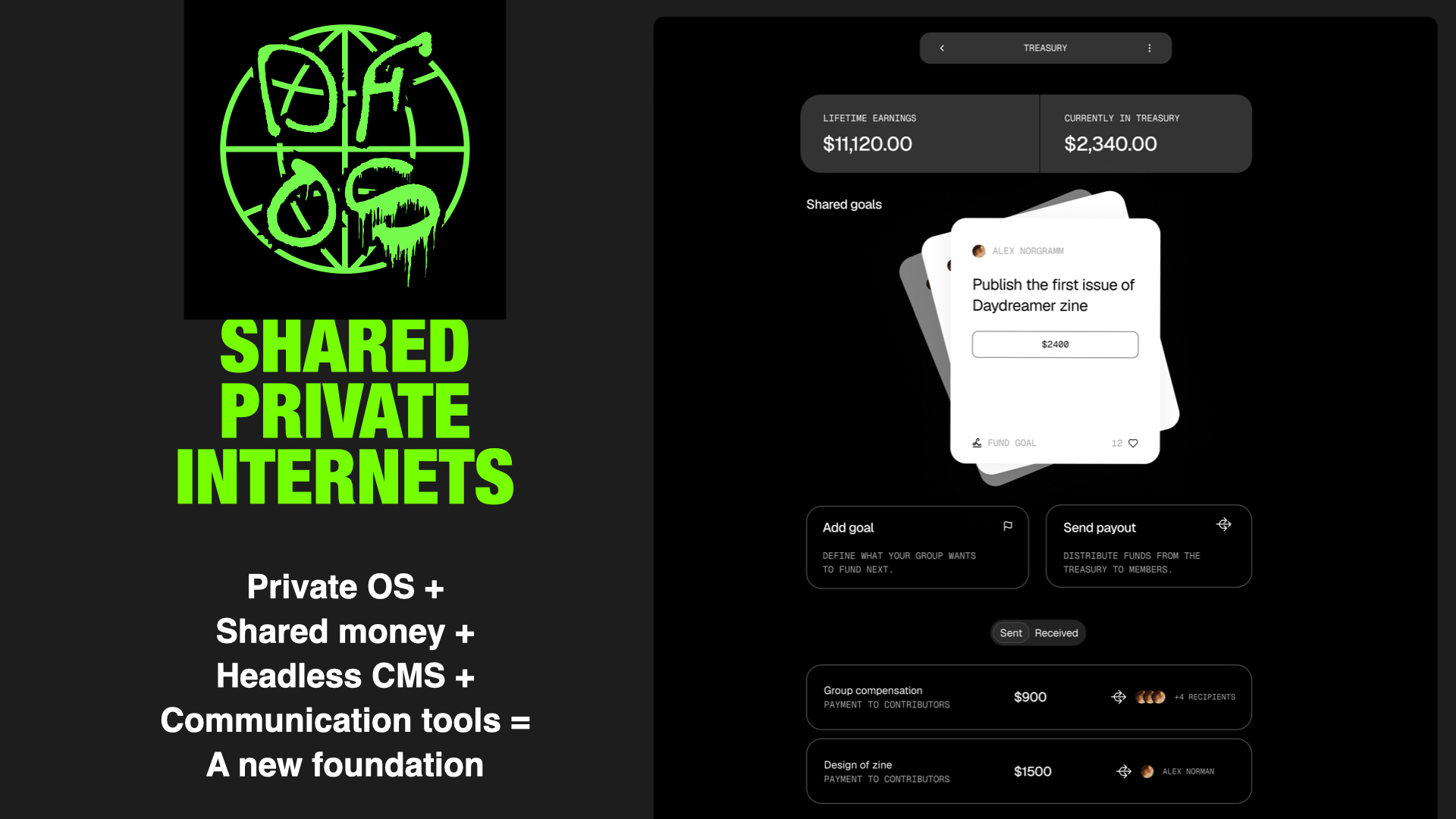
The private internet right now is scattered across tools. Groupchats. Google Docs. Disconnected. Things meant for other purposes. We're building an operating system for shared private internets called DFOS, or Dark Forest Operating System. A networked universe of shared desktops for groups of people to create, collaborate, and conspire together.
We built it as an operating system, where every space is different. Install new apps, like a groupchat, a private image feed, videos, or a shared treasury for money, and build exactly what you need and are.
DFOS has been open for a month. It's being used by bands, record labels, creative communities, small teams, design studios, and hundreds more creative squads.
We've also learned from the past, including our history building Metalabel. We intentionally designed DFOS as a collective operating system built on top of an underlying protocol that protects the work of the people who use it.
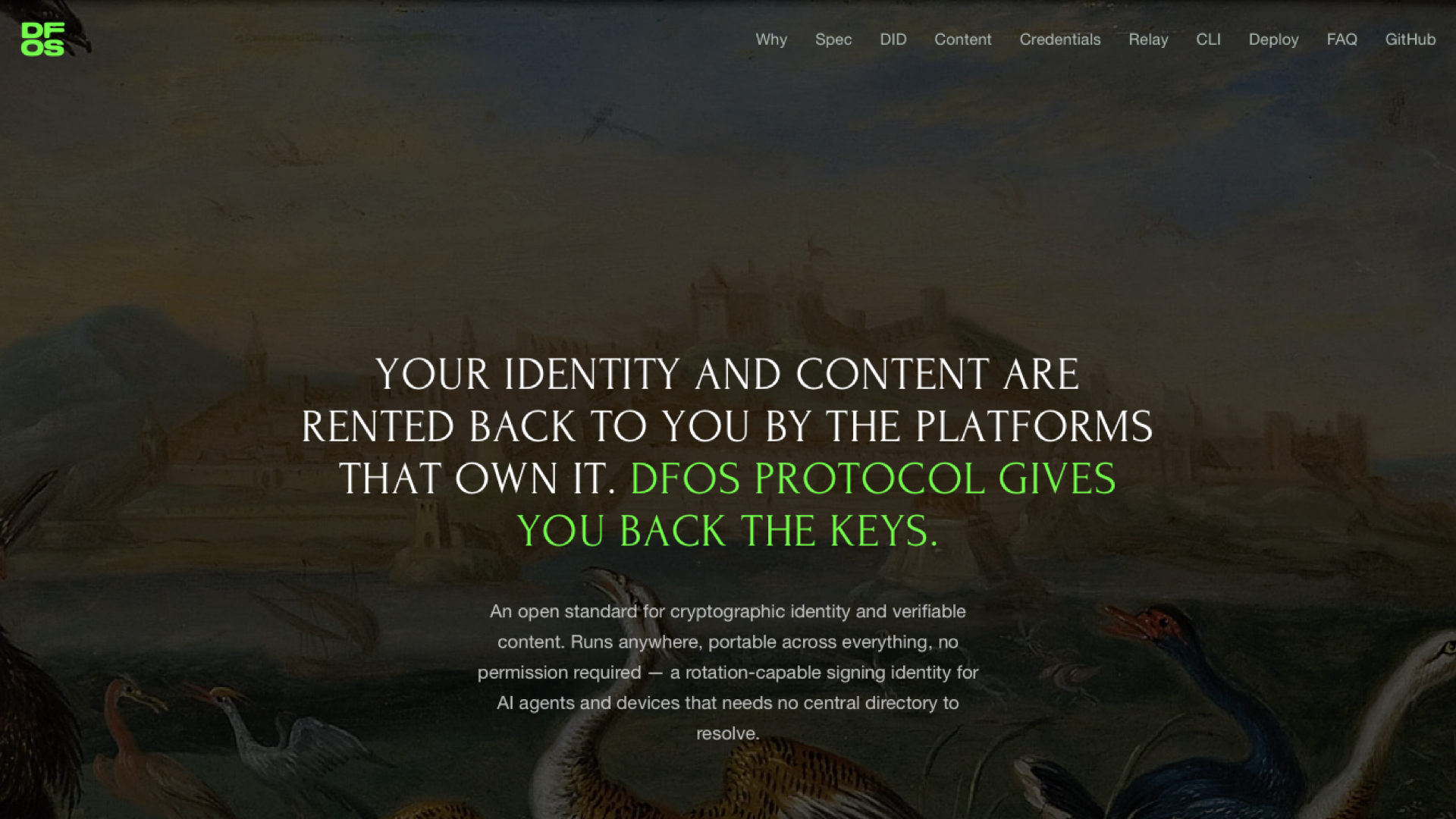
The DFOS Protocol that powers our world uses an underlying architecture of decentralized identifiers, an open, interoperable system that Blue Sky uses. But our protocol uses that structure to create portable private data that's always yours, and can be verified beyond our servers and even offline. A world where you always have control over your work, not us.
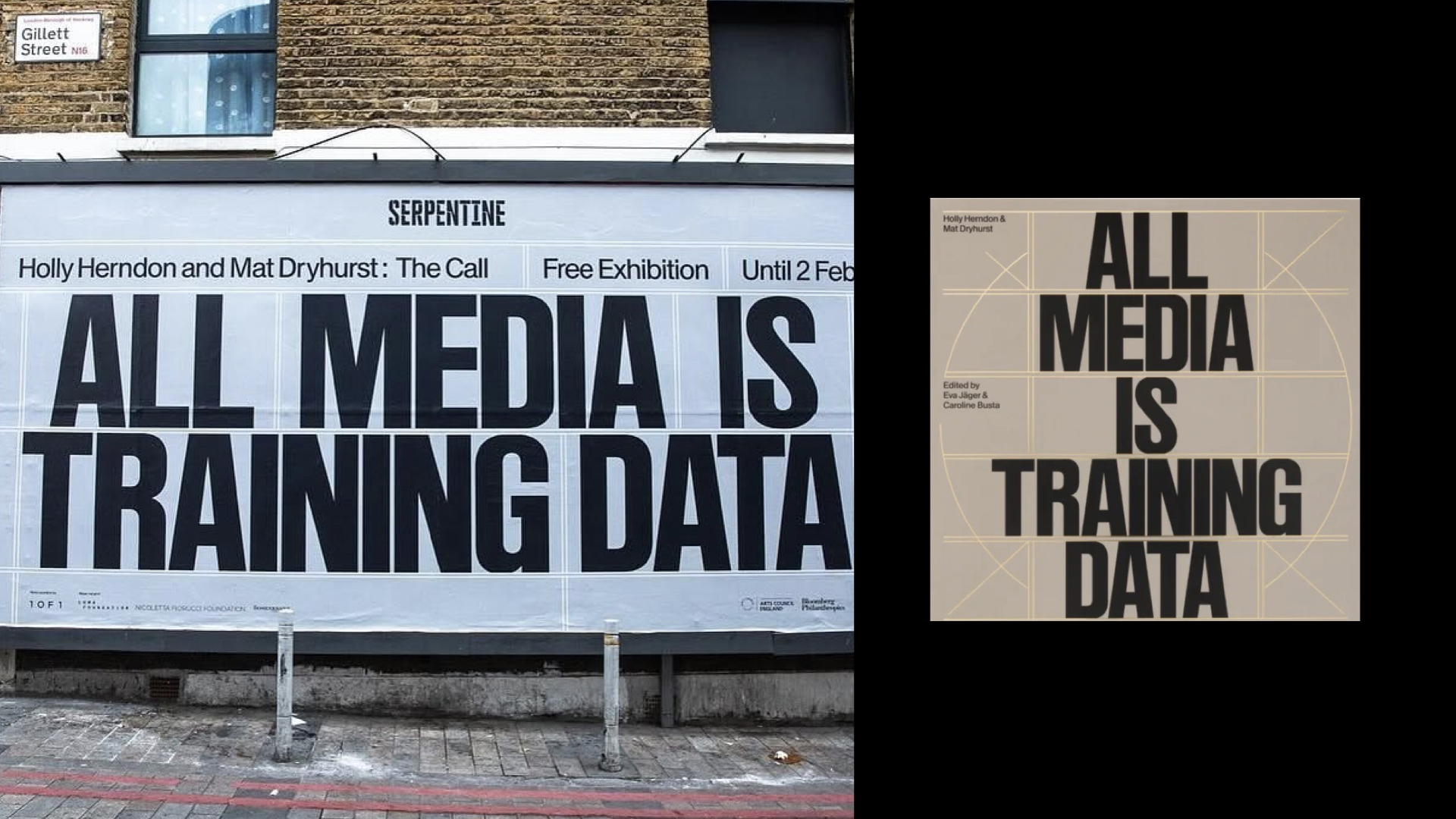
In DFOS everything is private by default. These are spaces that will not be indexed by Google, and can protect what's inside from unwanted eyes. In a world where everything is training data, the importance of being even more thoughtful and diligent about what we let into the light only increases.
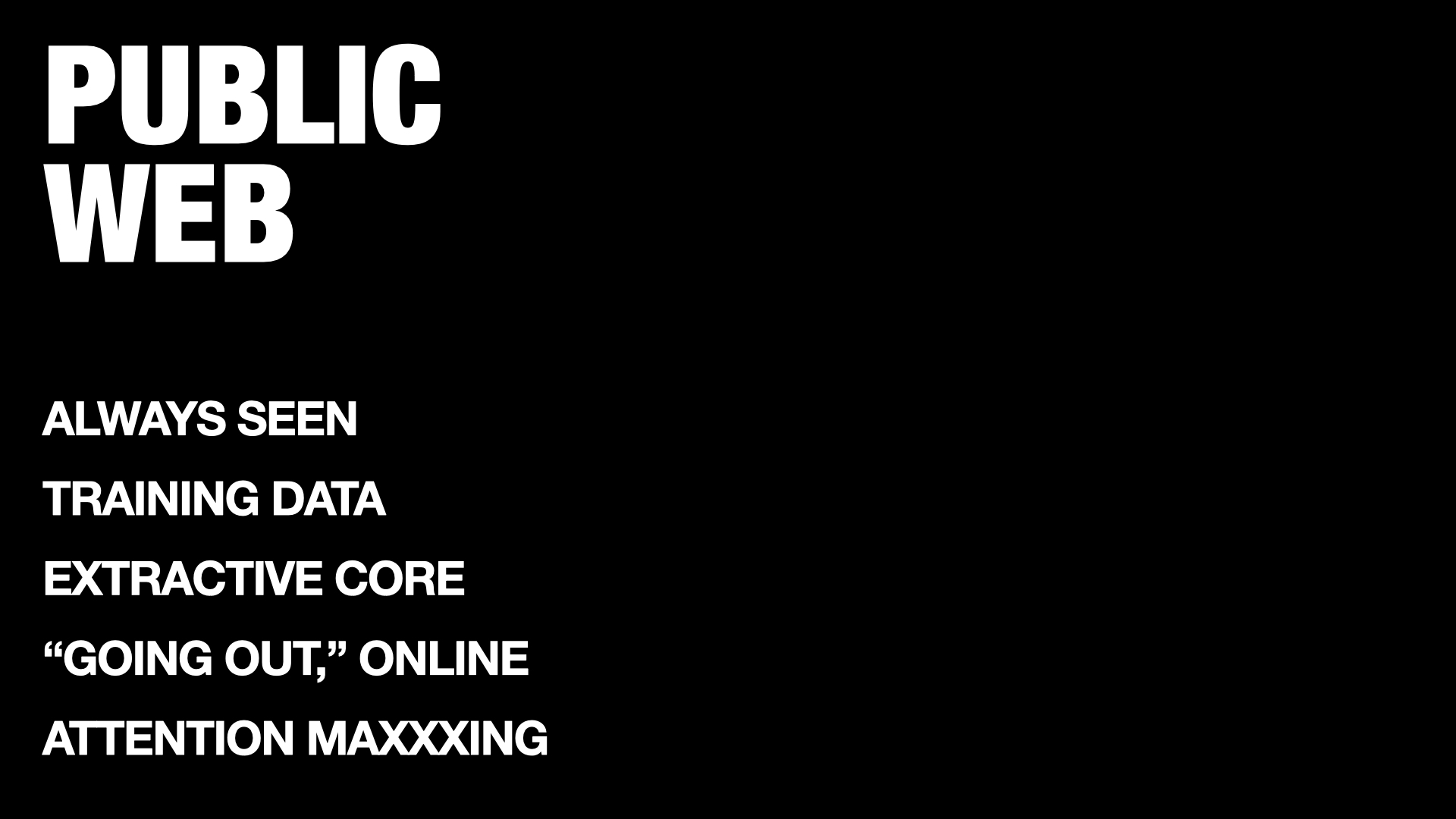
This moment is a divorce from one way of seeing the world into another. The assumptions of infinite scale of web 2.0 led inevitably to the extremities we see today, of content as slop, everything extractive.
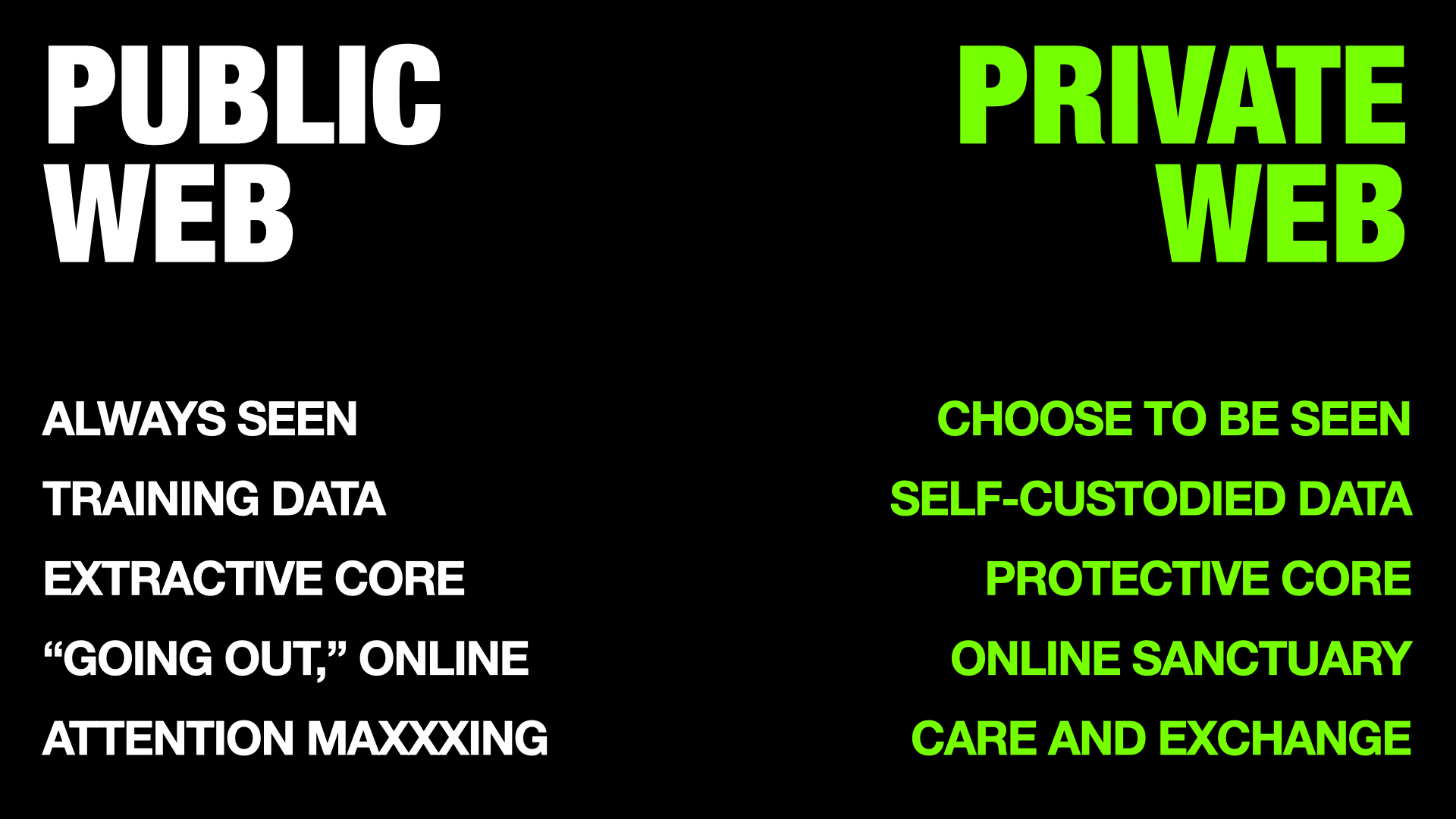
The private web enters as a counterbalance. A new online universe where we decide how we are seen. Where we hold our data by default. Where care and safety are assumed and preserved rather than constantly under threat.
The emergence of this schism will create a different relationship to the public internet. I can imagine a world where connecting to the public web is an explicit step we take, like connecting with a modem used to be. It will be the only way to know we are truly safe.
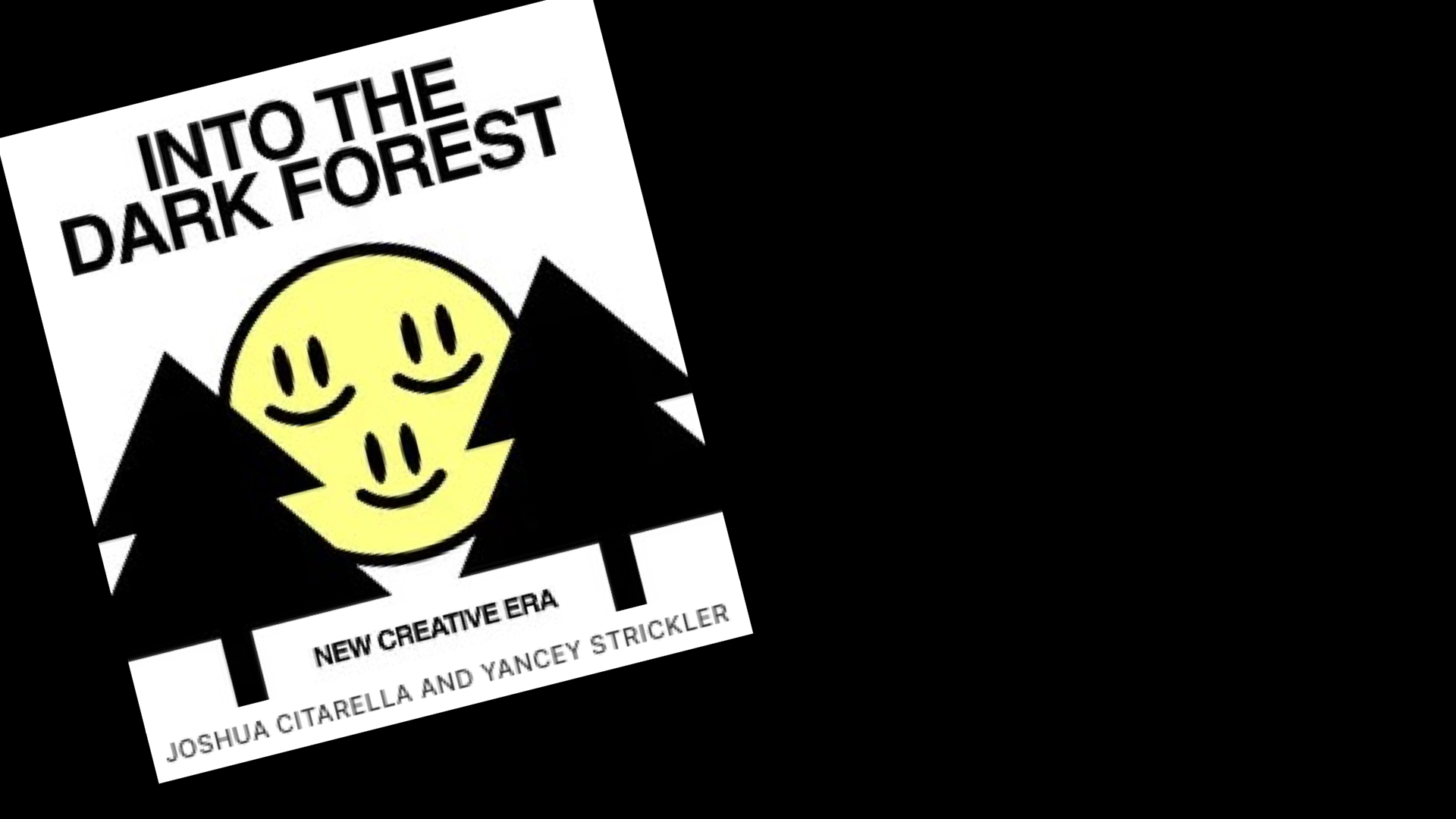
This world is neither a utopia or a distopia. As Josh Citarella and I discussed in the last season of New Creative Era. We explored and debated what purpose dark forests serve. What it means when Signal is used by the White House to plot attacks on Yemen. Has power moved to the vape-filled rooms of the groupchat from here on out?
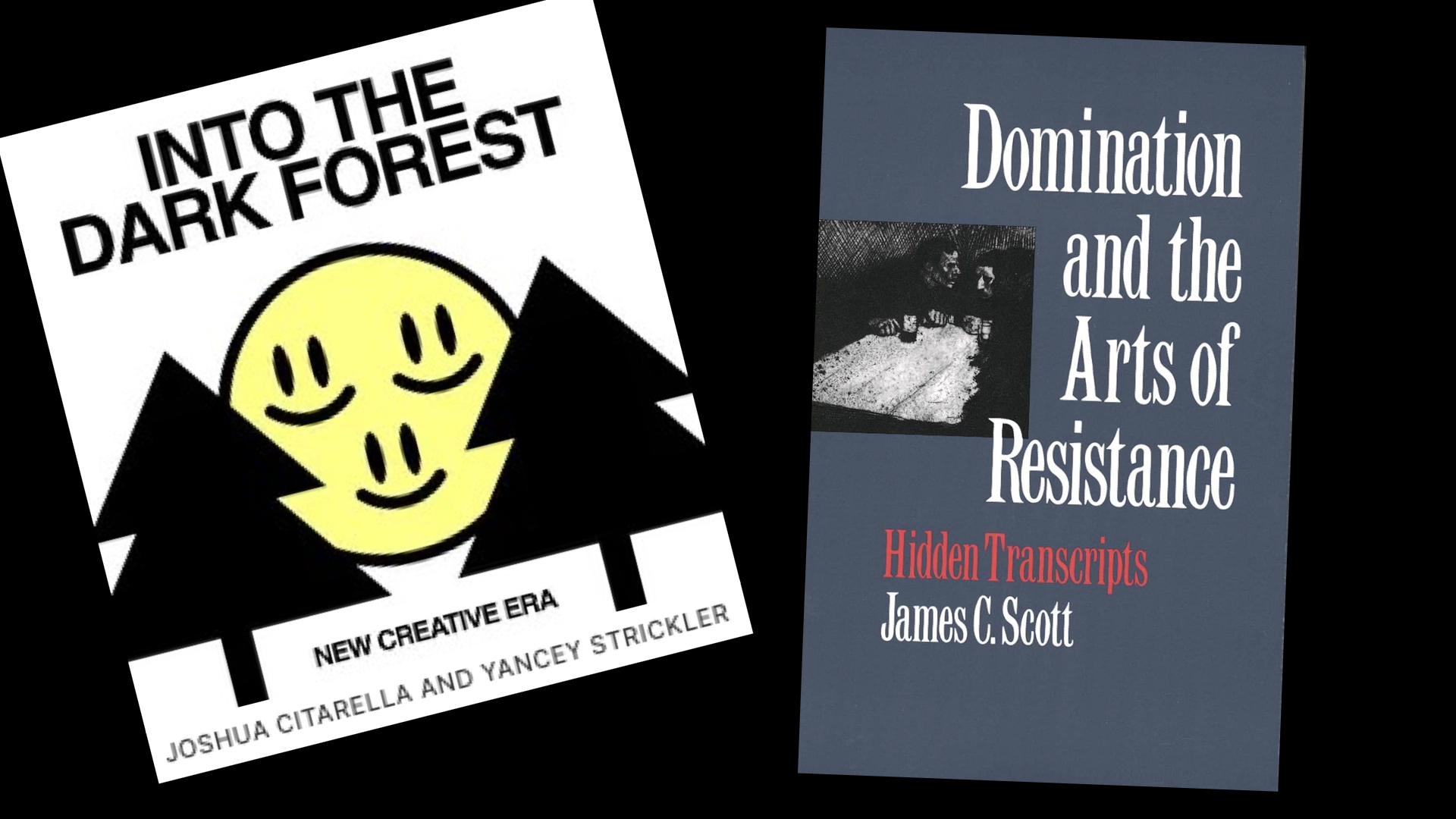
There's a great book written by James C Scott, author of Seeing Like a State, that explores how oppressed people and cultures survive domination. What he finds is they do this through the hidden transcript. The truths everyone knows but can only be shared privately. It's through these private connections that the seeds of the countercultures and challenges to the dominant culture later emerge in public get planted.
It's also important to ask whether a life of dark forests is a removal of civic responsibility.
Adam Curtis argues in the Century of the Self that the one side's retreat into self-help and yoga in the 1970s ultimately ceded the floor to their political opposition, and set the stage for the '80s and everything since.
There is still a wider culture and society to be defined and argued over, in which it is important to participate. We should not let go of our public space. We should not become digital homesteaders.
But it could also be the case that these private online spaces, which have more in common with the world before the internet than the infinite scale we're used to, will be the biodiverse islands where new cultures, ideas, and ways of coming together are created, protected, and spread. Not just in ways that agree with our personal politics, too.
My hope is a world where we feel safe to be ourselves online. Where the promise of connection, thriving subcultures, new ways of thinking, and coming together as something bigger than a collection of individuals becomes more central to our existence. Not just online. In all areas of life.
Isn't that the thing we're all searching for?
This is a breaking point. But breaking doesn't mean broken.
This isn't the end. This is the beginning.