Antienshittification
Cory Doctorow has a word for what happens to internet platforms: enshittification. First it's good for users. Then it squeezes users to serve advertisers. Then it squeezes everyone to serve shareholders. Finally it dies, taking everything you built on it with it.
The farther they get from their founding moment, the more extractive platforms become. We've all lived this cycle. The pattern feels like a law of physics.
We keep building our identities, audiences, and creative histories on platforms we don't control, hoping this time will be different. It won't be. Because the problem isn't the people running the platforms. It's the architecture.
The dark forest
In 2019 I wrote an essay that introduced the dark forest theory of the internet — the idea that surveillance, ads, and trolls had made the public web a hostile environment. People were retreating into private groupchats and invite-only communities to avoid the fray.
That movement has only grown since. It's become clear that the public, ad-supported spaces are not here to serve us. They’re adversarial to our interests and goals. We go online for connection and fun. Their algorithms trap us in ad-supported doomscrolls carefully designed to be hard to escape.
People move into groupchats, Discords, and private spaces — quieter corners, but still rented ones. Tools built for an earlier internet. They can't evolve with the communities inside them, and the data you build there still belongs to someone else.
Last year, Metalabel started working on a new platform that imagines a different world. Called Dark Forest Operating System, or DFOS, it’s a private internet of protected, member-governed spaces where people can be safe and real together in worlds of their own. Each DFOS space comes preloaded with a groupchat, private posts feed, shared treasury, DMs, and subgroups, and the ability to customize and expand the way each community sees fit.
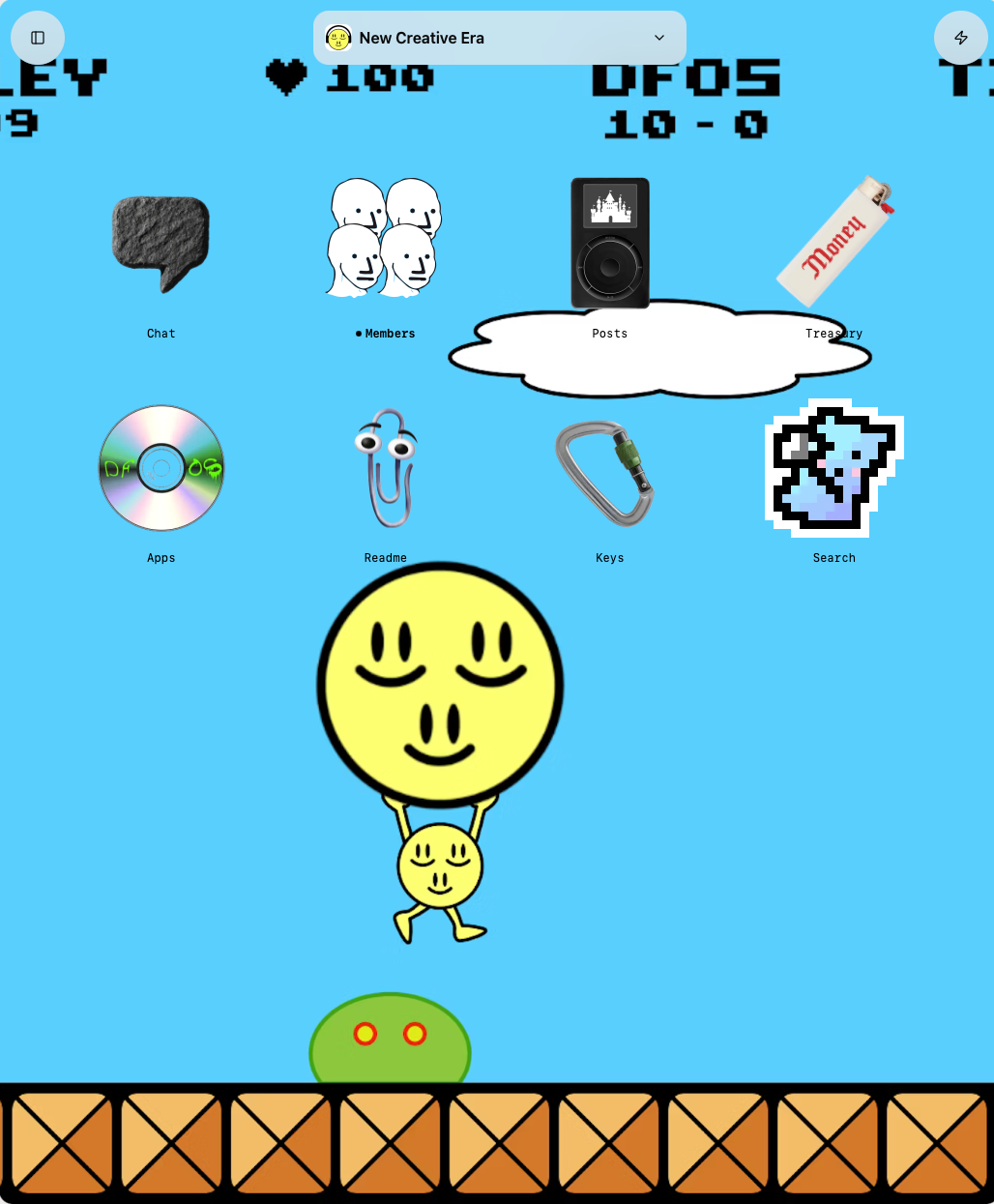
Crucially, this platform — which launches next month — isn't ad-supported and doesn't use algorithmic feeds to dictate what people see. There's no advertising layer or rage-based business model to feed. It's member-supported, putting people in full control of what they see. Our incentives are aligned with yours. We grow when you grow. If we fail to serve you, we fail, full stop.
Aligned business models are critical, but DFOS goes farther. Underneath DFOS is a protocol that makes it structurally difficult to extract your data without your participation, in a way that a terms-of-service change cannot undo.
We built DFOS to be antienshittified.
The DFOS protocol
Existing platforms own and control your data. You create an account on their servers according to their rules and exist at their whim.
DFOS is different. The architecture that runs underneath our service – the DFOS protocol — presents an entirely different approach to data, ownership, and privacy.
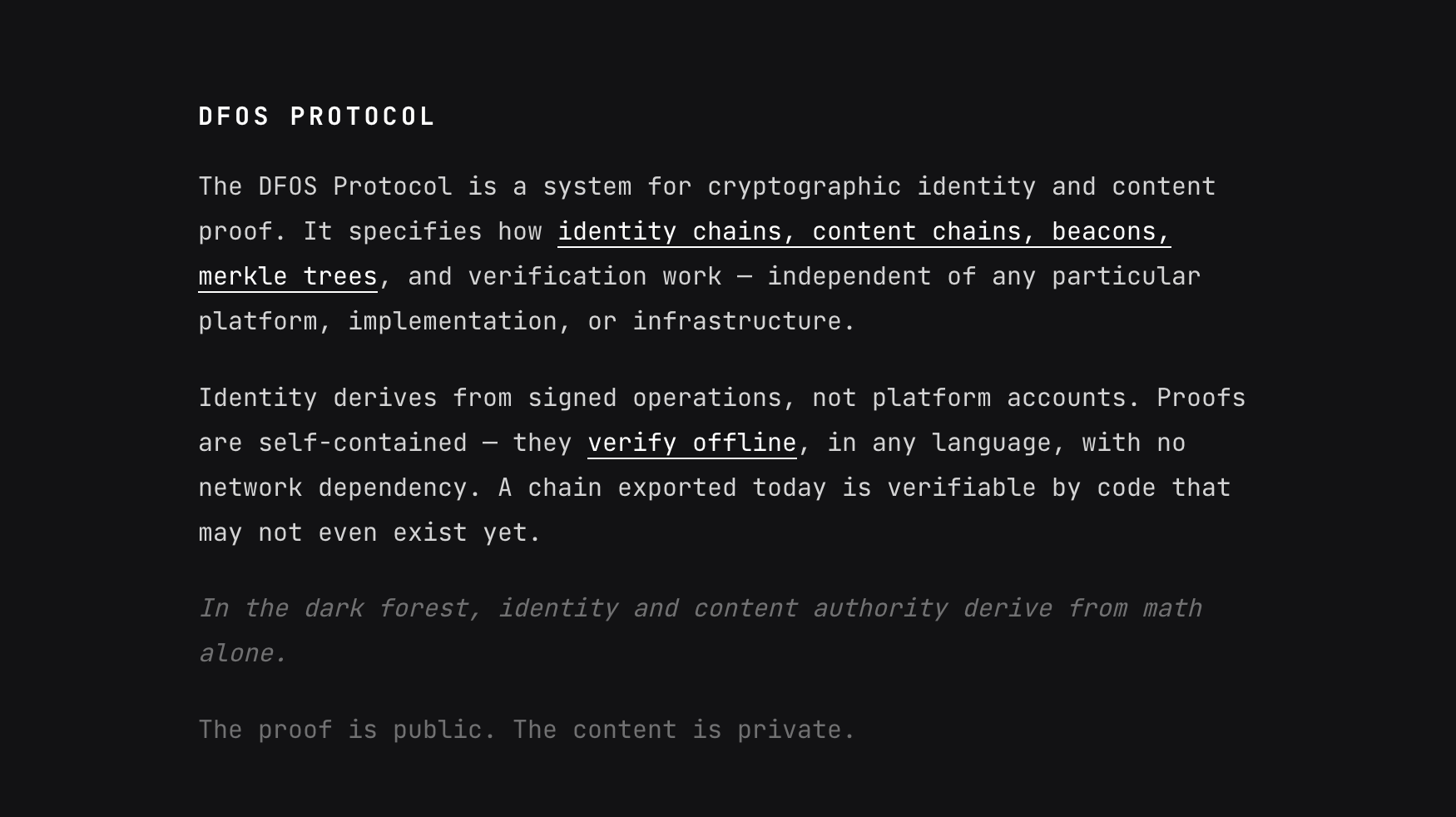
Instead of your data living within a username on someone’s server, the DFOS protocol derives your identity from cryptographic keys you control. Your identity is a signed record of your actions — a tamper-proof log that any device can verify, offline, without asking anyone's permission.
This happens using an open data architecture standard called a DID, or Decentralized Identifier. These are publicly available addresses that websites can reference that contain cryptographically protected information about a person and what actions they’ve taken. With DIDs, you can connect with sites and services while your data stays yours.
Your DID is a portable, consistent identity online, without the need for corporate overlords. The AT protocol, which powers Bluesky, also uses DIDs — more on it in a moment. None of this involves blockchains.
Content works the same way. When you publish a post through the DFOS protocol, what gets recorded publicly is a cryptographic proof that you authored it — not the content itself. The proof is public, but the content it holds stays private.
This solves another problem of the dark forest era: if everything is private and hidden, how do you establish trust, authorship, and reputation without dragging everything back into the extractive public layer? The DFOS protocol lets you prove you made something without revealing what it is.
DFOSBOX
As an example of what you can practically do, I made a simple app on top of the DFOS protocol called DFOSBOX. It's a Dropbox clone focused only on blog entries and comments I’ve made across the 16 DFOS spaces I’m in.
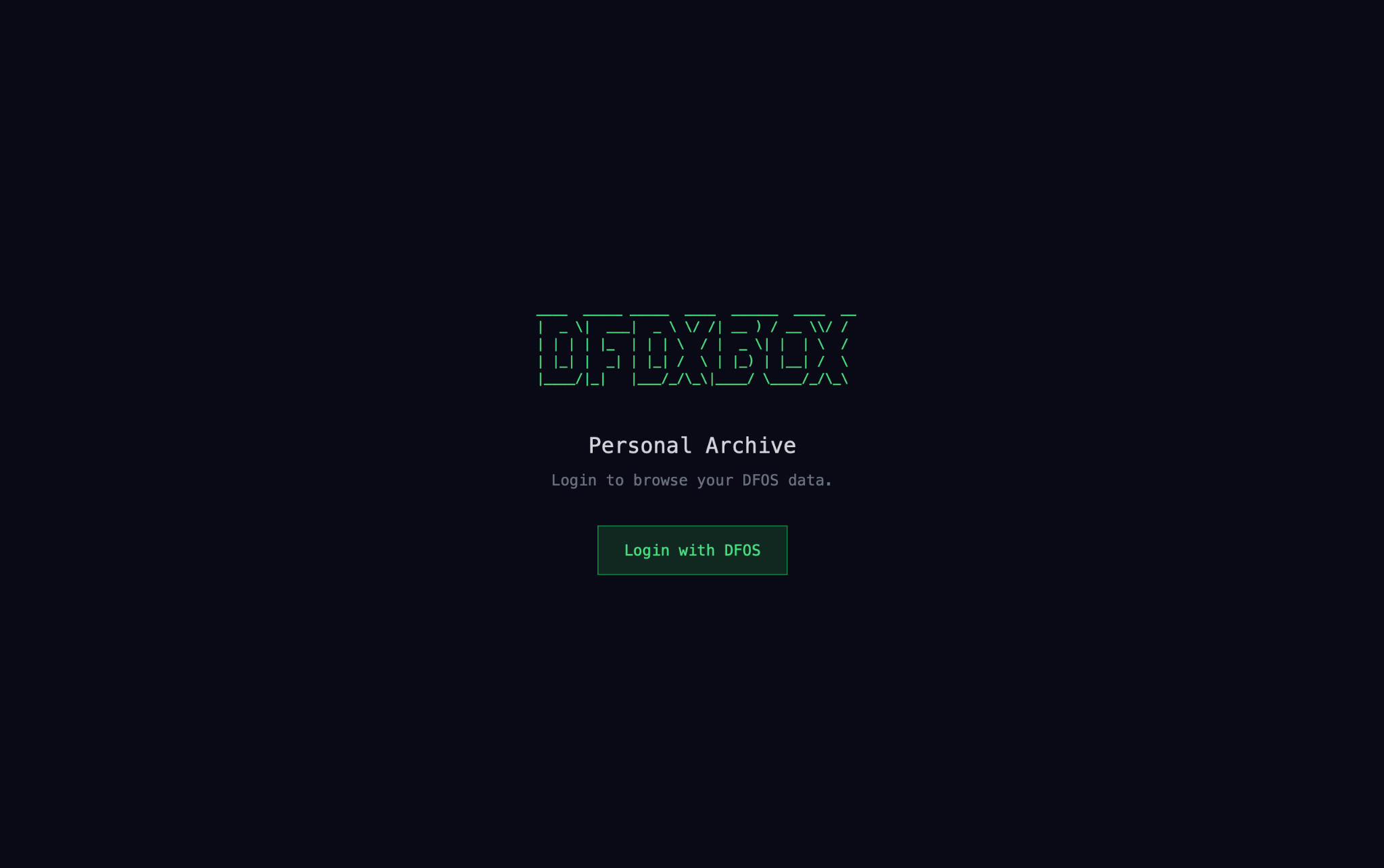
After logging in with my DFOS credentials, DFOSBOX visits a relay server that holds my data, checks my DID signifier, verifies it’s me asking, and then copies and syncs everything I've made to a folder on my machine. Every post, piece of content, and action gets mirrored to a location I control.
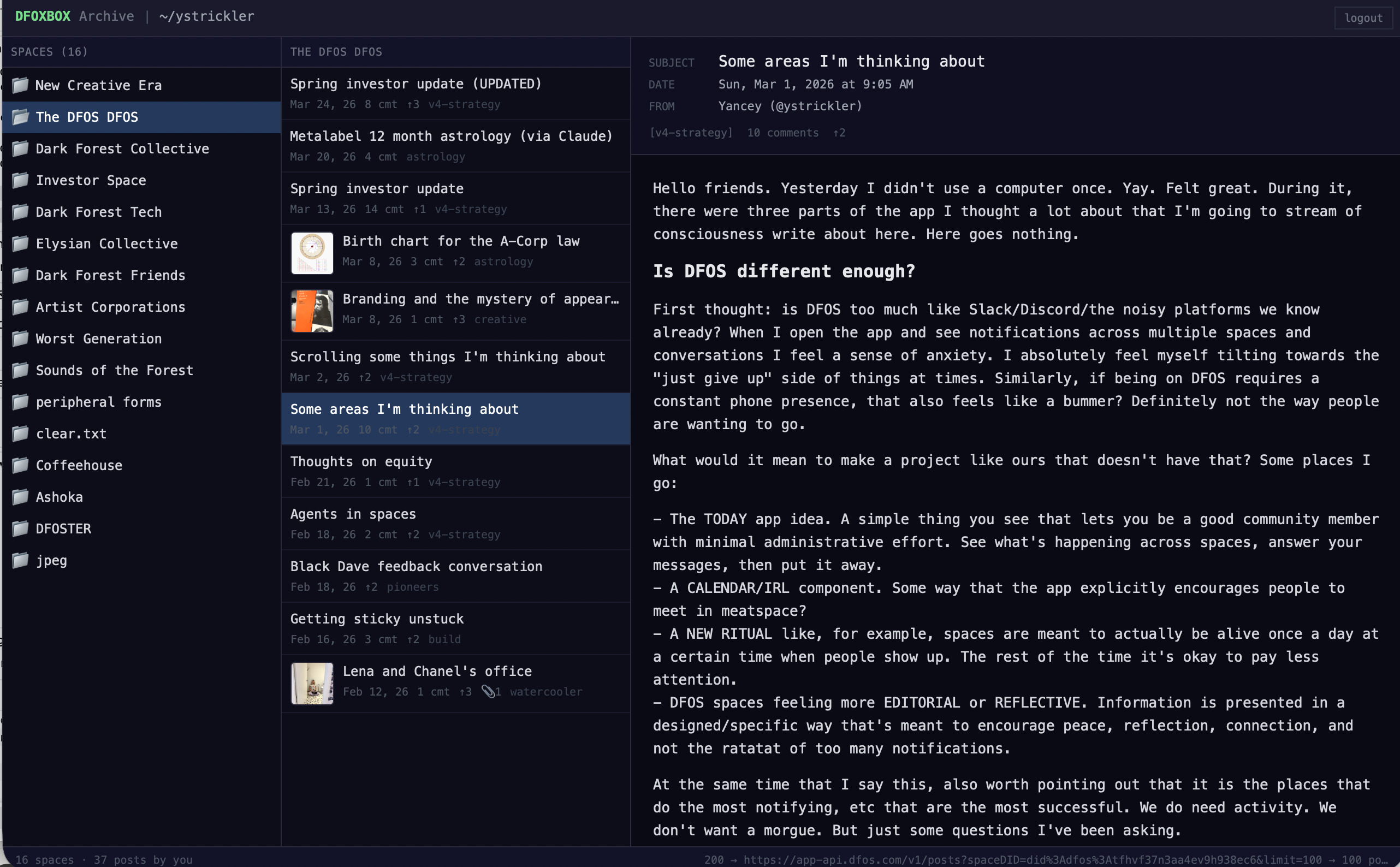
This means when a platform enshittifies — when it changes the rules, locks you out, or just goes dark — you’re protected. You already have your data, saved somewhere else, that's verifiably yours.
Imagine if other services did this. Every YouTube video, IG post, tweet, and Substack you posted would be automatically saved and preserved in a consistent structure fully under your control. That's what the DFOS protocol allows you to do.
DFOSBOX is a project I made, but I’m not the only one. Three other dev projects have already emerged in our ecosystem in our private alpha. Projects using the protocol to mirror their data and power complementary products beyond DFOS.
A changing web
We think this is just the beginning.
Arguments for adopting more advanced technical systems or more do-gooder tech often requires some sacrifice in end experience. It's harder, more complicated to use. This is not the case with DIDs. We're able to create what we believe is a more empowering, richer, and more intuitive product experience, while powerful capabilities underneath the hood open up something much bigger.
When we started using DIDs on Metalabel three years ago — prompted by my brilliant Metalabel/DFOS cofounder Brandon Valosek — we were inspired by Bluesky and the AT protocol, who laid the path. What's amazing is that even though the AT and DFOS protocols use DIDs for opposite purposes — AT to create a standard for decentralized public data, DFOS creating a standard for decentralized private data — because DIDs are simple, flexible, and open source, our two worlds can become compatible over time if developers wish, and extend into new worlds as well.
Read the protocol spec at protocol.dfos.com. If you're a developer, hop into clear.txt, a DFOS space for devs, for more. If you’d like to explore DFOS, join the waitlist.
The internet belongs to everyone, not the few. Its technical foundations should too. Welcome to our forest.