Building in private
For the past year I've been consumed by two projects that have taken shape mostly in private. Doing the work has been more important than talking about doing the work.
This has been a relief. As much as I love to write and communicate, I find myself wary of being too public about what I'm doing and thinking. It starts to quickly feel performative, not who I am. To be able to immerse myself in a project deeply with only my closest collaborators and friends knowing what's going on, suits my nature much more.
But in the next few weeks, both projects will become either newly public or public in a sharper way than before.
I want to share a bit about those projects and what they mean to me. I also want to emphasize that, despite recent mantras about the importance of building in public, in my experience quality work depends on the rich potential of focus and privacy to encourage taking chances, finding novel solutions, and making leaps forward. Depth and time are far better friends to developing work that matters than attention and popularity.
DFOS (Dark Forest Operating System)
The first of these projects, the Dark Forest Operating System, or DFOS, is explicitly about privacy and these exact questions. DFOS is a new kind of shared private internet. A desktop of apps, files, and capabilities that you and your group — and no one else — can see and use.
This week we leaked an alpha version of DFOS to Metalabel's most hardcore community (the sickos, as I lovingly call them). The experiment has been a huge success. Hundreds of people joining and using the system, and more than 200 people online at the same time.
People seem to like it. Four quotes from within DFOS:
- "Haven't closed my DFOS tab since joining. I can see how this can become a 'thing' for communities of all types"
- "Feels like we're all pulling up to a peaceful village in Southern Italy, and breathing air for the first time in decades"
- "I clicked on the link in my email with no idea what to expect and I have to say that I am completely obsessed with this....space."
- "Amazing space, as others mentioned. I feel like I just stepped into a void on the internet in the best way possible, haha. Clean and undiluted, shrouded in darkness that indicates a new beginning."
One irony: we've made a product that's inherently private, however it's also something we need to speak publicly about. This is an awkward dance to handle, and one an increasing number of us are dealing with. That shift between mass channel broadcasting and private channel connection is important, and something DFOS approaches in new ways. More soon.
The full proper release will be in April, and we'll be gradually expanding our private beta until then. Ideaspace readers can check out the space we made for my podcast with Josh Citarella — the first DFOS space open to the public — here. There's a tension and a buzz with this project that feels right.
Artist Corporations
The other major project of the past year that will be coming more into focus is Artist Corporations. Now the A-Corp work has been fairly public so far, but it's the private part of the work that's been most consequential.
Last year I made four trips to Colorado to connect with business, cultural, and political leaders about the possibilities of Artist Corporations in their state. Thanks to readers of this newsletter (thank you Ryan!) I got connected with actual politicians and important people in Colorado. After lots of work behind the scenes making connections and sharing ideas, we find ourselves on the brink of the first-ever A-Corp law being introduced as legislation very soon.
A bill proposed and a bill passing are very different things. There will be hearings and a whole process to go through. Soon we'll publish the actual text of our draft bill, which breaks new ground for how creative businesses can be structured. It proposes a new platform for how creative people commercially engage with the world.
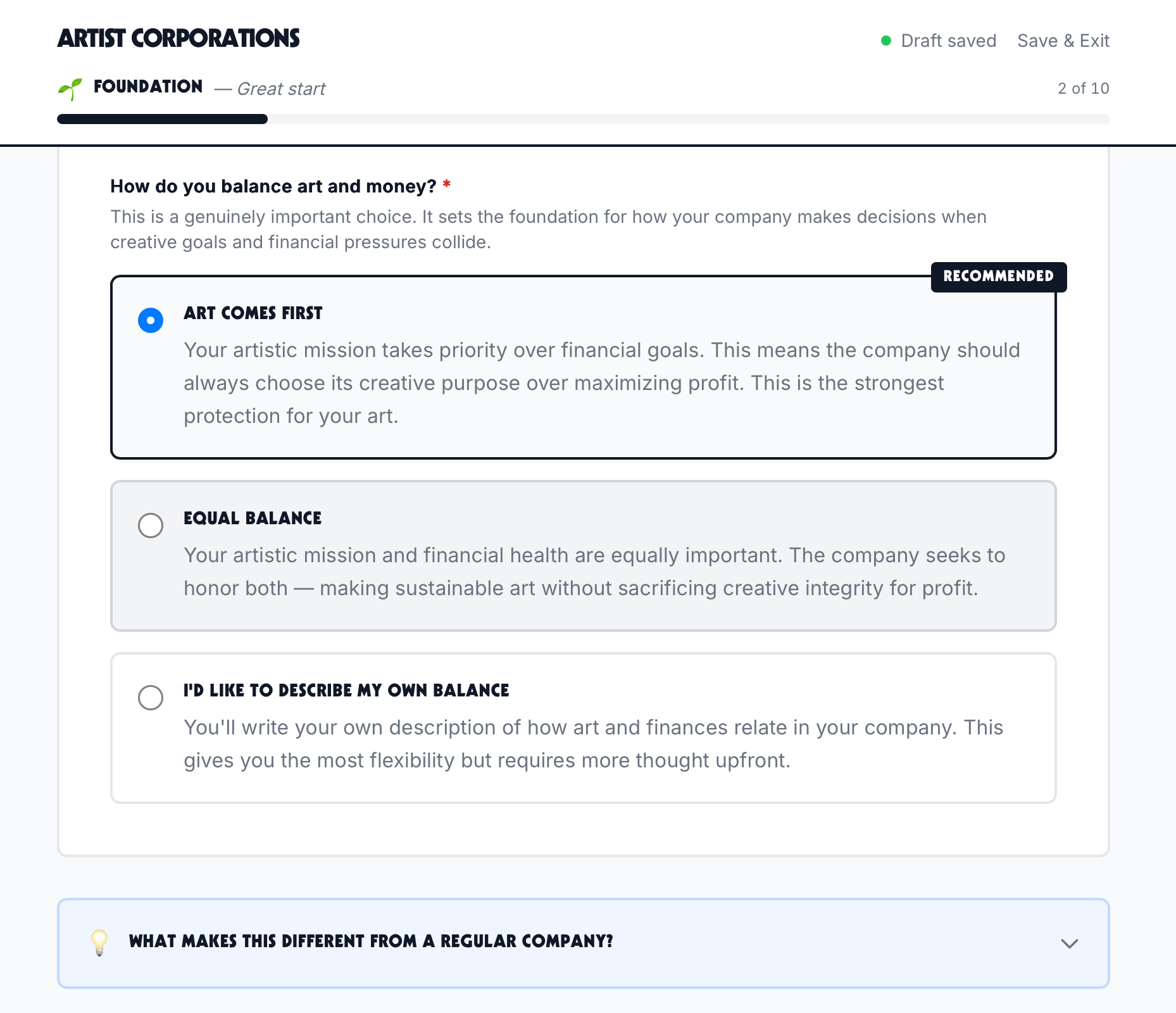
People more experienced in lawmaking keep telling me that to be in this position after a year is remarkable. This progress has come through building connections and relationships with people who share the same dreams, combined with the power of the idea itself. The public elements of this project have been critical for opening doors, but the most significant progress has taken place in private.
What happens in private
In both cases while the work was private, it was far from solitary. Both efforts stem from extremely small groups of people — no more than four or five humans on either project, all of us experienced in what we do, with zero overlap in duties or skills. This allows for a collaborative culture where everyone unleashes their unique skills to make these projects happen.
I have very high hopes for both projects. I believe they are novel, meaningful, and will materially shift how people live online, as well as how creativity intersects with the commercial world. These are projects meant to spiral into something much bigger than me and the small group of people who started them. But it's also the case that the process of making them, in private, with people I respect, is its own immense, unforgettable reward.